How to Become a Creator in the Metaverse
QuHarrison Terry Mark Cuban Companies Growth Lead · Author
QuHarrison Terry leads growth marketing at Mark Cuban Companies and co-wrote The Metaverse Handbook. A conversation about creators, digital ownership, and building an audience in virtual worlds.
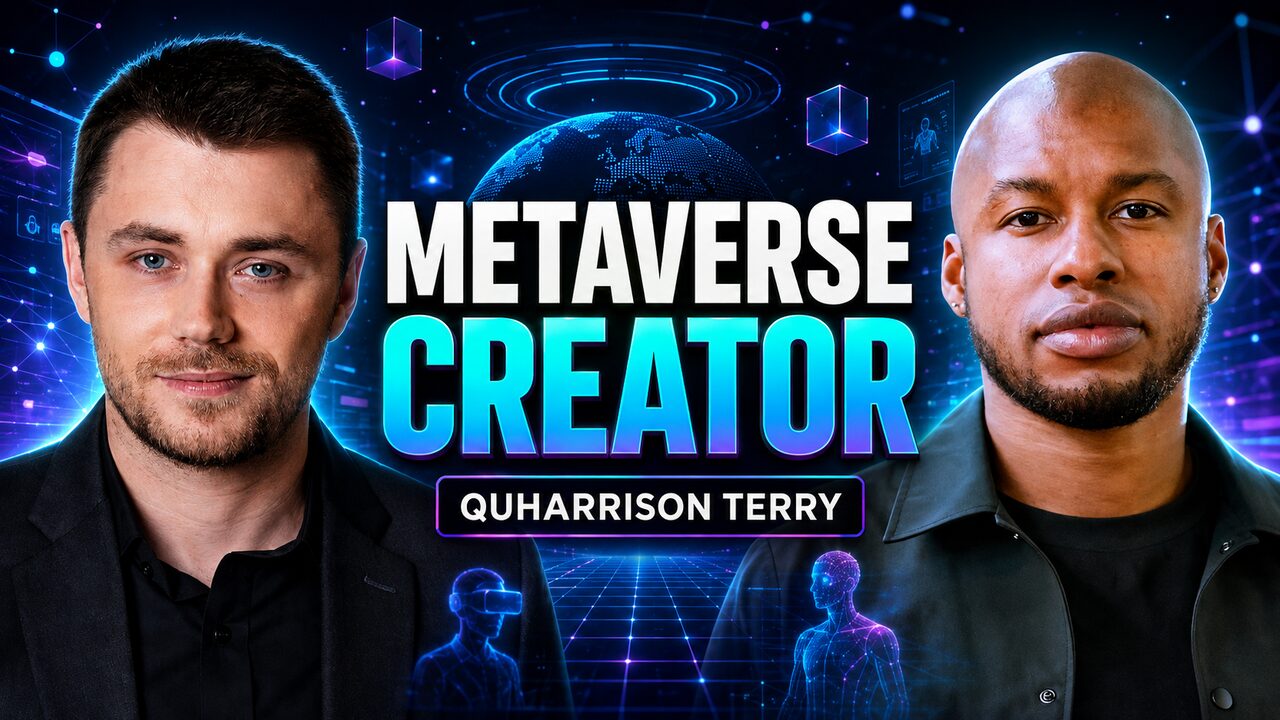
- QuHarrison Terry calls the metaverse the catch-all term for the spatial internet: the next evolution of the web, still in its Nokia era of big, clunky headsets, which is why he says skeptics who claim it does not exist yet are “kind of right”.
- Beyond gaming, Terry sees education and training as the most untapped metaverse use cases, from unlimited virtual screens for learning to adaptive digital humans that onboard employees.
- Terry’s advice for aspiring creators is to learn tomorrow’s tools today. Gravity Sketch, Unity, Unreal Engine, and Stability AI are the future Photoshops and Figmas, and early skills compound into a real advantage.
- For companies, Terry recommends putting on a headset, exploring platforms like Decentraland, Spatial, and Roblox firsthand, partnering with native creators, and starting with small engagements instead of a big corporate pivot.
- Terry expects metaverse advertising to be more effective than skippable YouTube ads because users are locked into the experience like in a video game, and first movers will be the brands everyone talks about in five to six years.
Who Is QuHarrison Terry?
Watch this part · 0:00Kevin Hi everyone, welcome at Wavect. Today with QuHarrison Terry, who is growth marketer for Mark Cuban Companies. He also just got featured on CNN, Harvard Business Review, Wired, Forbes, and is co-host of CNBC's primetime series No Retreat: Business Boot Camp. He was also speaker at CES, TEDx, and many more. And today we're going to talk about how to become a creator in the metaverse. Thank you, Qu, for being here. It's really a pleasure having you on. And yeah, feel free to share with us, what are you up to, what are your passions, and how does your day look like?
QuHarrison Yo, what's up, what's up? Obviously, I'm passionate about everything metaverse. And even if we're not in the metaverse, I'm always tapped in with the NFTs. So I like the world of Web3. I really like emerging technologies. I like to think about what kind of futures we'll be living in and what type of impacts those futures will have on our lives. And when I'm not doing that, I'm also helping companies grow. People like Mark Cuban and Joe DeSantis. So, having a lot of fun with it.
Kevin That sounds awesome. Awesome. You just showed, I think it's your book, if I got it correctly, right? The Metaverse Handbook.
QuHarrison Right. Both books.
Kevin Both?
QuHarrison Yeah, The Metaverse Handbook and The NFT Handbook. We wrote them both.
Kevin That's awesome. I will definitely put the links into the description for everyone who just got interested.
What Is the Metaverse, Really?
Watch this part · 1:47Kevin Referring to that, right, you just showed the metaverse book. I'm sure not everyone watching this might be familiar with it, right? And many people even claim that it doesn't exist yet.
QuHarrison That's true.
Kevin Could you maybe give people some kind of personal point of view what you think the metaverse is?
QuHarrison So the way I like to think about the metaverse is, the metaverse is just the catch-all term for what we're largely describing as the spatial internet and the spatial web. So the metaverse, as I like to refer to it, is largely the space where we will go beyond the screen. The internet as we know it today is largely experienced on these devices, the iPhones, the iPads, the Androids, all that. And it's a pretty one-dimensional way of experiencing content. You're just looking at the screen, and you're not really there, you're not immersive. And all the companies are doing things to enhance the current experience. Even the AirPods and the AirPods Pro, they've got spatial audio, right? And we've got on computers now, they mimic the Dolby surround sound. And so everybody wants to get to the space where you're fully immersed, no matter what you're looking at, you can kind of feel it. But the metaverse is how we're going to visually do that. And so when you hear terms like volumetric, I'm not even going to get into all this, the bigger terms, but in marketing speak, holograms, right? This is what the metaverse is trying to get us to. We're going to go from talking to people on FaceTime, and it's just your little image, to, I could drop you on my desk and we could have this conversation right here, even though you're all the way on the other side of the world and I'm across from you.
QuHarrison There is this new telepresence, one that's captured in this spatial environment. And today, that's largely experienced on headsets such as these, this is the Meta Quest 2. They've got other, more expensive headsets that you can tap into as well. But we're at the beginning. And the thing that makes it super exciting is, there is this world where we can envision what this immersive hologram, mixed reality world looks like, but today, as it stands, we're nowhere near that. And so when you hear people say the metaverse doesn't exist, they're kind of right. I can't be like they're wrong, but I also have to challenge that. And the reason why I use the word kind of is saying that, hey, the same way we didn't go from cell phones to the iPhone. We went from cell phones, and those were like big, big, like car phones I'm talking about, not cell phones when they got sexy, but the big blocky joints that were in the cars that had these long antennas, to then we got to the candy bar phone. And then we got to the first version of the smartphone, which was like a Palm Pilot, or like a mono color display, or it was like green. And then finally they had three colors and you could view blue, black and red. And then we got to the BlackBerry era, where we had the keyboards and it was more of a communication device.
QuHarrison And then we got to the feature phone era, which was the Sidekicks and the candy bars where you flipped up the phone and you had keyboards, but they weren't necessarily BlackBerrys, because that was more for professionals. These were more for, hey, I want to send a text, but I don't want to use a T9 keyboard. So then eventually we get to what we now know as the Android and the iPhone era. There was a long time before we got to that period where this became ubiquitous. The metaverse is very much in that Nokia era, where we have these devices, they're big, they're blocky, they're not sexy yet. And the best thing about it is, all the companies that are working on this domain know that, and they're focusing on, how do we make it so it's more natural, so it's more immersive, so it's more ready to go. The thing that I always say is, if you gave an iPad to a baby, even a phone nowadays, like the iPhone. I was babysitting the other day, and the two-year-old knew how to open and unlock my phone. Not in the sense where they're just pressing random buttons, but it knew how to swipe up, to try to get the Face ID prompt. And I was like, golly, that's just intuitive to you. I still struggle with the swipe-up Face ID, especially when I'm in the airport and I'm wearing a mask, and it's like, move your face, and I'm like, I still don't have it down to a science. But to a two-year-old, they get it, it's just unlocked. And that's where we need to get with the metaverse before I think people will say it's real.
QuHarrison So I know that was a long-winded answer. To wrap it up and summarize it, the metaverse is just the next evolution of the internet. The internet's evolved, cell phones have evolved. And people are like, well, what do you mean, the evolution of the internet? Well, the internet's been a lot of different places in the last 30 years. When you think about the internet as we first knew it, it's dial-up, and people got on, and it took a long time, it took two minutes for a page to load, and it would populate all the images, and then you would look at it and scroll and click on another button, and then it would take another 45 seconds. That was the first internet that I grew up with, right? And then we got to the internet where things started to be populated by other people and contributed, like you had blogs, and we had Wikipedia. I don't know if you remember, but being in school, you used to get chastised if you were using Wikipedia, because they were saying it was all fake information. I was in that era where we had Wikipedia and we thought it was the coolest thing ever, because all your citations were already done. It was like, man, I'm just gonna Wikipedia and just pull the citations there. But your professors were not having that, so we had to still do this encyclopedia thing and learn how to format APA and MLA the correct way. But now that's all a click of a button, largely because of apps and extensions.
QuHarrison But after we got out of that version of the internet, we got into probably the most exciting and most well-known version of the internet, which is the mobile internet. So the internet went mobile. We were able to take the internet with us wherever we went, and in that process we were able to unlock apps like Uber, Airbnb, largely even Twitter and Facebook, and just so much of what we now call, let me get on the web and spend some time there. So it's exciting to see that we're about to transcend and go to a new direction. We all got a glimpse of it if you've ever played Pokémon Go, and we're just amazed at how cool it was to have Pikachu follow you at the park, and then you can take it to your classroom, or to work, or you could take it in the car, like even bring it back to the house. That was cool. But again, it was experienced largely on the phone. There's going to be an era now where, as simple as just putting glasses on, you'll be able to put glasses on and people will be able to then see all the information they need. And there's even some companies out there that are working on smart contact lenses, so people that don't want to put the glasses on can just put the contact lens in. The next decade and a half is about to be super exciting. So that's the metaverse. And I know that was a long-winded way, but I wanted to give people something that, if you're listening to this or watching this, you could look at and be like, oh, OK. I can see how this is more than Fortnite or this is more than Roblox.
Kevin Awesome. Hey, that's an awesome answer. Thank you for that.
How Immersive Will the Metaverse Get?
Watch this part · 10:12Kevin After hearing all this, I would be curious now, where do you think all this stops? Right? Because there are also companies where you basically have some sort of gloves or something like that, where you get even the feeling when touching something in VR, for example, right? Where do you think are we heading with these kinds of... You're muted.
QuHarrison No, I'm here. OK. I was going to say, I think it's going to get really, really, really immersive. And it's going to be a fun experience, largely because you're going to be able to play football and feel what it's like to catch the ball. You're going to be able to get to a point where you are in a boxing game, and if you get hit, you're going to be able to feel what it's like to get hit. Now, obviously, it's not going to be damage inducing. It's not going to be like your ribcage is getting broken. But it's the same way that, when you pick up a PlayStation controller or an Xbox controller, you feel the vibration and it gives you a sense of immersion to the game. It's not exactly what that action or essence feels like in real life, but it's a tactile way to engage and call your attention. And we're going to have more inputs and sensors that allow for that type of interaction within the games, I think. I mean, not even within the games, but within the next version of the internet, which we're calling the metaverse.
Kevin I love it. Yeah, that sounds super exciting, especially when thinking about the little kid in me, myself. GTA and all these kinds of games that people usually play. It's just exciting to watch what's going to come.
What Will People Use the Metaverse for Beyond Gaming?
Watch this part · 12:03Kevin Besides gaming, what do you think? What kind of applications could be there for the metaverse?
QuHarrison So beyond gaming, I think education and training is going to be one that we haven't even scratched the surface on. In the education sense, think about YouTube. You use YouTube, right?
Kevin Yeah, probably.
QuHarrison What's the last thing you learned off YouTube? How to do what?
Kevin Good question. I'm watching a lot of podcasts, usually mindset, leadership, things like that.
QuHarrison Got it. So mental models, you're just learning how to work through certain difficult situations or break down things. It's like you're using it to get your mind up, right? I get it. There's some people that learn how to draw off YouTube, there's some people that learn how to build robots off YouTube, there's some people that learn how to fly a plane off YouTube, right? All of those things I just described, people will also do in the metaverse, and there's going to be a certain immersion that you're not going to be able to capture with YouTube. If you want to learn how to draw on YouTube, it's best if you have two or three screens. Because you got what you're drawing, and then you got your reference, and then you have the actual tutorial. That's super hard, man, to get a three-screen setup. So not everybody has that.
QuHarrison And so when I think about where we are in today's day and age, in the metaverse, I can give you a headset, you can have as many screens as you want, you have your own command set. And then here's the best thing, I tell you to press a button or do a function, and you can also see what's going on in the real world simultaneously. Imagine not having to have the clunky desktop environment that you have with the screen and the bezels. We're getting to a world where that's not needed anymore. When you put the headset on, you can be in a plane or a Formula One car or even a spaceship, and you can get the actual controls and feel the same essence of what it's like to be a pilot. Not in the sense where you're getting a G-force, we're not there yet, but maybe we will, because you were talking about the sensors. There probably will be some chairs and some suits, flight suits, that you'll wear that give you that feeling as best as they can today. We're not there yet, but it's going to be a possibility thanks to the technologies that we have when it comes to training. One of the things that we're into today is, you go in the workplace, and today someone has to show you how to do whatever your job is, and they walk you through it. Tomorrow, that could be a digital human, and it's programmed to say, this is how this is done. And you can correct that digital human, but that digital human will do it perfectly and have the best way of teaching the person down to a science.
QuHarrison And here's the best thing about it. It doesn't matter how that person wants to learn, that digital human can adapt, because it was programmed to do that. You already have the essence of digital humans today amongst us. When you look at the Amazon Alexa and the voices that are included on that, the Google Assistants, the Apple Siris. When you look at those three avatars that I just mentioned right now, they don't have a face. They don't have a presence. But we're going to get to a point where they can embody and take on many different presences and have many different ways that they interact with you. And it'll be kind of like Cortana in Halo, if you ever played Halo. And Cortana, and how she would just pop up in Master Chief's, in his visor. And it was very hologram-like. But we're going to get to a point where you're communicating with non-player characters, or NPCs, in ways that we hadn't even thought of. And if you like this idea or this mental model that I'm on right now, I talk a lot about that in The Metaverse Handbook, Chapter 1, A Vision for 2032. I talk about how bots will go beyond these annoying things that we have today on Twitter and in Discord and Slack, and give us something that we all can participate in, partake in, in the virtual economies that will be built off of that. That's something I talk about in The Metaverse Handbook.
Kevin That sounds super exciting. Really, especially just thinking about, you're sitting right in front of your desk and suddenly such a small avatar pops up and helps you in some kind of way. Right. Even if it's just us asking a simple question, and maybe it gives you some kind of real instructions in a visual way, right? How you can solve something or do something, right?
How Big Is the Metaverse Creator Economy?
Watch this part · 17:13Kevin It starts from the very simple instruction side to more complex problems. Everywhere where we have some kind of information flow, there will be people that try to produce some kind of content. You just released, I think it was today, a post on LinkedIn where you talked about creators being in the metaverse at some point, right?
QuHarrison Yeah. Yeah. I like you, man. You actually go and do research. And it's funny, I've done a couple of interviews today and you're the first person that's actually went and looked at some of the content I create. So thank you for that. The metaverse creator economy is one that, this is one of those things where this could be a whole podcast, and I think I'm going to make, I have the note. And what you were referring to is, every day I think about what's the future. It's a question I ask myself. I say, what's the future? What's the future? What's the future? And I see these things that happen and I just kind of ideate and take notes on that. This is my notebook. I've been doing this since 2015. In 2022, I had the idea to say, hey, let me open up my notebook to the masses. And it was a little weird, I'm not gonna lie. I didn't get around to doing it until Q3 of 2022. But it's now done. And that is my real notebook.
QuHarrison So what you just mentioned, I'm thinking right now about the metaverse creator economy. And the creator economy, as we know it, I think the last that I saw, it was from August 2022, and I think it was a little underneath half a billion dollars is what it was valued at. And some of these stats, take them with a grain of salt. They're just inputs, right? I don't know if it's more or less, but it's one of those things where I just see these numbers and I take them with a grain of input. They say the gig economy is just above a trillion dollars. And you think about that for a second. The gig economy is the Ubers, the... I mean, what's a gig? I don't want to just own it. What's a gig economy gig that stands out to you?
Kevin I'm thinking of Fiverr, for example.
QuHarrison Fiverr is a great example. Yeah. So Fiverr, Uber, TaskRabbit, there's all these small gigs that people are doing in that economy. The way that people are looking at it, they're saying it's over a trillion dollars, which is fascinating. Right now, the creator economy is just about a little under half of that. And when I think about the metaverse, it's like, hell yeah, that's coming over to the metaverse. Because whatever is happening in the real world, I'm letting you know now, and we can look back at this in 15 years and we can see if I'm right or wrong, but I don't think people and their interests are going to change that much. I don't think that that's true. We've been through a lot of technological shifts and innovations. The reason why Disney is just as apparent on streaming networks and in the video world and even on YouTube is because people like Disney's content. So that wasn't going to change from the VHS to the DVD to the YouTube stream, and now even Disney Plus, right? The affinity for Disney is still there. The affinity for, let me think, getting your nails done in the metaverse, going to drag shows, getting, I don't know, singing, people dancing. All of these things I just described, I can name actual creators that are doing it, and doing it in a profitable manner, in the metaverse today. When I say profitable, they're not millionaires, right? But they've made a few thousand dollars.
Kevin Also, when we compare the amount of people actually being in the metaverse versus people being on YouTube, it's like, oh man, this is going to change. I think the amount of people actually being in the metaverse is going to change. I think the amount of people actually being on YouTube and all these traditional social media channels, I think that's already huge, right? That you're even able to do that. That's already crazy.
QuHarrison Right, yeah, right.
Which Tools Should Future Metaverse Creators Learn Today?
Watch this part · 21:41QuHarrison I mean, when I think about what someone asked me, what are some of the things or software that I could use to become a creator in the metaverse? The thing that I've been practicing just personally is Gravity Sketch, because I want to be able to, I think it'd be so cool to do a presentation in a mixed reality format where you get in Gravity Sketch, you have all your models, and then in Gravity Sketch you have different paintbrushes. You remember Disney Channel way back when, you remember when they used to make the Mickey Mouse ears with, whatever that magic wand thing was? We can do that today in the metaverse. You just go, you can recreate the Disney Channel commercial, if you want. And that, to me, is so fascinating, because that's a new form of storytelling. That's a new form of content creation. We watch people play video games on Twitch, but we're going to watch people go in and do Gravity Sketches probably the next four to five years, right? It's just the skill set hasn't been built there yet. So that's one thing.
QuHarrison The next thing is, there's going to be people that look at Unity and Unreal Engine for games. And they fall into that, and there's always going to be probably a community for that. But we're starting to see Unity and Unreal Engine get used for other things, like movie production. A lot of people don't know this, but there's also several people that do. If you've ever watched The Mandalorian, a lot of the content that was shot in The Mandalorian was on a virtual background that was designed in a game engine. That's crazy, right? So you could learn this game engine and go and create Hollywood-esque productions in a matter of probably a few years. So that's just two examples. If you go to the site, it's everydays.wtf, and I'll give you the link, forward slash 30, the number three zero, you'll actually be able to read all my notes on what it takes to be a creator in the metaverse economy, and what tools you should be looking at and just testing out yourself today. Because these will be the future Photoshops and Illustrators and Xcodes and, I don't know, I mean, Figmas of tomorrow, right? Those are tools that we all use as professionals, Final Cut Pro, all that stuff. Had you learned that 10 years ago, you'd have a leg up today.
QuHarrison You learn OBS today, you could be a pretty good streamer, right? If you learn Unity, you can learn how to make 3D environments. If you learn Gravity Sketch today, you can learn how to do 3D design and modeling. If you learned Stability AI, this is one of those things that a lot of people have comments on, but probably don't know how to actually use. But if you go figure out how to use this open-source AI platform that is used to create art. I don't know, have you seen the AI-generated art?
Kevin Yeah, sure.
QuHarrison Yeah, yeah, yeah. So if you use Stability AI and you get familiar with that, and you know how to type in exactly what you want, and that machine gives you exactly what you want every time you do it, you're gonna be one heck of a threat, because you can generate your own images. I mean, you're a content creator, imagine if you could just generate your own thumbnail and it was the best thumbnail ever. You would never lose! And you don't have to spend any time in Photoshop.
Is Any Creative Job Safe from AI?
Watch this part · 25:34Kevin You said what? Those are actually some crazy thoughts, right? Especially because people always thought all creative processes are actually safe against AI. Now, even that aspect.
QuHarrison I mean, AI is bringing a challenge to everything and anything, and I think that that's good, because stagnancy is not growth. And if you want to grow, you want to be impactful, you've always got to be practicing your craft, but you've also got to be on the cutting edge. You've got to learn what new innovative techniques are being developed or what are the discoveries. If you're a doctor and you go out and you only stay closed-minded, meaning you only practice what you learned in school, every year you get away from when you graduated, you're gonna become less and less and less effective as a practitioner, as a medical doctor. Why? Because you're missing all the advancements, all the new research and findings. Everything that has come to life since you stopped paying attention are things you could leverage to be better at your craft and save more patients or help more people. And quite frankly, I would never want a doctor that didn't pay attention to the industry.
QuHarrison And so you would never want to be an artist that didn't pay attention to the industry. You never want to be a podcaster that didn't pay attention to the industry. You would never want to be fill-the-blank-in that didn't pay attention to the industry. So if you didn't pay attention and AI kicked your ass, I have no problems with that. I think that that's your problem, right? You deserve it. But if you stayed in and you were like, yo, look at this algorithm, and you started to say, hey, I'm not gonna learn this algorithm, but I'm gonna find some people that do know it, and I'm gonna work with them, and we're gonna figure out our way of this. That's the move. And it's just tough right now, because there's so much. This is a big, big industry. And it's daunting. But because it's daunting, you know, Web3 and just NFTs and the metaverse, the reason why I wrote these handbooks is because I knew that if you wanted to learn and you were a non-technical person, there's not a lot of resources for you to just jump in and not get inundated with all these things you won't understand.
QuHarrison And so I wrote The Metaverse Handbook so that if you wanted to understand why people are so excited about the metaverse, why did Mark Zuckerberg change the name of his company, which was formerly known as Facebook, to Meta, why is he investing all this money, why is he hiring all these artists, read The Metaverse Handbook. You'll get a glimpse into what he sees and what a virtual economy could entail. If you want to know why people are spending millions of dollars on what you would think of as screenshots or JPEGs or whatever, go check out The NFT Handbook. You'll get a better understanding of why digital collectibles are something that every brand and really creators should be paying attention to as they start to think about their digital identities and what they release as products over the next 10 to 12 years. And it's just a super exciting time. And yes, it's daunting, but if you spend a little bit of time, like 10 pages a day, on either one of my books, you'll be done within two to three weeks. And you'll have a great understanding of some of these new topics that largely would give you a competitive advantage today.
Kevin 100%. It's always about that compound effect, right? If you improve yourself 1% every day, which means doing your research, then you actually grow as a company, as a person.
QuHarrison Yeah, I think the stat there is, in 70 days you'll be twice as good as you were when you started, right? Just in 70 days, if you're just doing 1%.
Kevin Crazy.
QuHarrison Every day, right? So it's like, that's absurd.
Kevin 100%. And that actually should create the urgency to actually act now, right?
Where Should Companies Start in the Metaverse?
Watch this part · 29:39Kevin I would have one last question for you, if that's okay.
QuHarrison Sure.
Kevin One major concern of many companies might now be that their target audience is not on the metaverse yet, or that there are many metaverses, like Decentraland, Sandbox, whatsoever. They don't know where to start. What is your take on that?
QuHarrison So if you're a company and you're trying to figure out where your audience might be in the metaverse, I would first tell you, or whoever you're assigning to the task, to pick up a headset, put it on, and go see for yourself what's there. I've solved a lot of problems just getting people engaged and immersed in the actual platforms, right? And what happens is they go off of everybody, or they go off and they say, oh, the kids are here, and so it's only kids here. Or, VRChat looks weird because I watched this movie on HBO Max. That's great, right? But you won't know if you like it or what opportunities you see until you actually go and try it. So I recommend going to Decentraland. Go see how the interface is. Get familiar with it. Go into Spatial. Go into Roblox. Go into Altspace. Go into a Bigscreen VR session, right? The reason why I'm having you try it is because you'll get a chance to see what opportunities exist, and if you think it's a great fit for your brand, because you know your brand better than most.
QuHarrison And if you're B2C, the reason why this is important is because you're probably going to partner with some of the creators that are in those spaces, right? So you're going to go in and you're going to say, oh, I see Serena Ellis doing a DJ set. Let me work with her. Well, if you want to work with Serena Ellis, you need to understand how she DJs virtually and what that show entails and why people show up to her concerts. If you're going to go to a virtual drag show, you got to know what Nicki Fuego is going to get into and what the crowd is like, and how do they talk, and how do they support each other. You got to understand that. And if you've never been there, you never showed up, it's just going to be really hard for you to catch that wave. So I would say, check that out. And then ask yourself, how can we do a small engagement that will let us learn more? Everyone thinks way too big when they jump into the metaverse. Unless you're changing your whole corporate trajectory and this is going to be your 20-year plan, it shouldn't be a major shift to the metaverse today. It should be a gradual shift. It's something where you start, you get some exposure, you learn, you adapt.
What Can Brands Learn from Early Social Media?
Watch this part · 32:37QuHarrison And you think about the brands that leaned into social media in the early days. It wasn't that they went to social media and said, oh, we're going to up our sales. They went to social media and they built trust, and they understood the platform. And by way of doing that, they were able to build some incredible understandings, which gave them leverage. I always point to Nabisco, the Oreo. You remember the Super Bowl? I forgot which number Super Bowl it was, but basically the power went out at the Super Bowl for a brief second. And Oreo made a tweet where it says, you can still dunk in the dark. And this was before brands were on Twitter, and still, brands weren't a big thing on social media yet. And everybody pointed to Nabisco and Oreo saying, oh my gosh, this is the most talked about tweet of the Super Bowl. They got so many impressions. And largely, that was due to them just leaning in and just getting some exposure to social media. But there was no way that they knew, before they got on that platform, that their exposure and them learning how to use social media correctly would lead to an effort that would outperform their own Super Bowl commercial that they spent millions of dollars on.
Kevin It's actually crazy, right? One more recent example could be TikTok. Many brands just thought, no way. And now it's going to be busy.
QuHarrison Exactly. If you were a brand that showed up on TikTok three, four years ago and you listened to Gary Vee, you would be riding pretty high right now, because everybody's struggling with Facebook and what once worked. And you would already be immersed in a new culture. And the way that TikTok works is a lot different than what we know as advertising in the digital sense, even two, three years ago. TikTok is, that could be a whole show. But it's more about the shock, and then what is the storytelling and the awe that you end with. And again, we could do a whole show on that.
How Will Advertising Work in the Metaverse?
Watch this part · 34:51QuHarrison But to wrap this up, if I were a brand and I was going into the metaverse, I would, one, look at the creators and see if I could partner, sponsor, or get behind and empower some creators. Because all the creators, they're going to be the people that bring the people in, right? You think about YouTube. It was the creators that brought the first viewers and showed people what could be possible. Brands came after that. And now brands kind of run YouTube, in the sense that they're either sponsoring every single creator that you like, or they are literally buying the ads on the creators you don't know, or that they don't know, right? So it will become a branded experience. And that's the second point, if you have any type of business acumen and you're looking for a big, big business. Once the people are figured out, that side of the equation is done, how do you do advertising in, one, covert ways, but then also, how do you do it in explicit ways? Neither path is defined, right? So if I want to do a covert, subliminal marketing campaign, I'll do a brand deal and you just work directly with the influencer. If you want to do something that's direct, you just buy the ad through the self-service platform that is offered.
QuHarrison And that works until it doesn't. And we're seeing the self-serve stuff not work so much, and we're seeing brand deals get really, really expensive. One place that that's not true is the metaverse, because it hasn't been defined in any capacity. So you probably can get a little bit bigger of a bang for your buck, but the problem is the number is going to be a little smaller. But because the people are in there, they're in there, they're locked in like a video game. I would say that advertisements in the metaverse will be a little bit more effective than 10-second advertisements on YouTube, simply because you're not going to really skip your metaverse experience. If you've ever played a video game, I always think of Legend of Zelda, because I think that that's a comparable metaverse situation. You go in and you're playing as Link and you're trying to solve all these quests, but you got to talk to people, do all these things. There's an attachment to the items that you collect. That's the metaverse. So there's so many ways for you to pop up and just be a part of that experience. And the brands that figure that out and get to that now, and just have that, however long, first mover advantage, they're going to be the ones that everyone talks about in five to six years from now.
Kevin 100%. As Gary Vee puts it, underpriced attention, right? As you just said, it's easier to grow in such environments, compared to Facebook, Instagram, or maybe soon even TikTok, right? And yeah, I would say thank you, Qu. I don't want to block more of your time. Really, thank you, thank you, thank you for being on here. It was a pleasure.
QuHarrison Appreciate you having me.
Kevin And yeah, really, it was an honor. And yeah, thank you, everyone, for watching.
Questions this episode answers
Want this kind of thinking applied to your product?
We build MVPs and act as fractional CTOs for founders who'd rather ship than talk.