Decentralized AI as a Public Good
Michael Heinrich $350M Raised · Co-Founder & CEO, 0G Labs
Michael Heinrich is building 0G as a modular operating system for decentralized AI, combining chain, storage and compute. He explains why verifiability, privacy and shared infrastructure could matter to enterprises, how 0G plans to win developers, and which AI-agent use cases may arrive first.
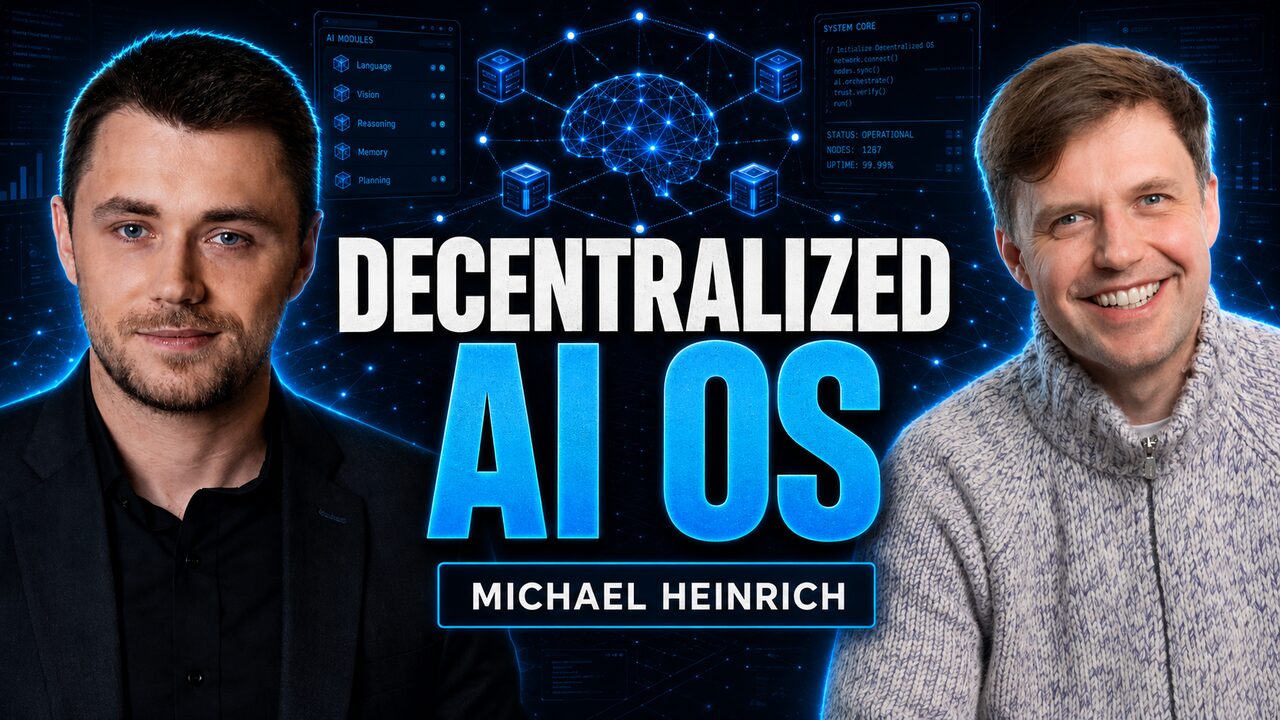
- Michael Heinrich argues that making AI a public good does not conflict with building a large company. In his model, people contribute compute and data, retain ownership, and earn rewards while the platform earns fees from compute, storage and transactions.
- 0G’s modular approach lets developers choose how public or private each workload should be. Heinrich points to encrypted data access through Beacon Protocol and federated learning through Balkeum Labs as examples of privacy layers built on the ecosystem.
- His enterprise decision framework starts with the locus of trust: whether a company wants to trust one provider or verify how a model was trained and used. He also highlights privacy, CapEx and operating cost as practical buying criteria.
- Heinrich describes 0G’s go-to-market model as a combination of a differentiated AI position, strategic business development and milestone-based incentives. The retention loop is “get, keep, grow”: acquire builders, keep the infrastructure reliable, then help their products expand.
- He expects trading and treasury agents to be among the first useful applications. Longer term, he wants communities to train and own specialist models together, contribute distributed compute, and earn from the models they help create.
How can AI be a public good and still support a business?
Watch this part · 0:00Kevin Wavect, the Web3 software company that understands what you want. Hi everyone, today I'm going to talk with Michael Heinrich, CEO of 0G Labs. And they're building basically an AI-native Layer 1 that lets you build high-scale and privacy-preserving AI applications. And it's a super exciting episode. I definitely would love to hear your feedback on this session. And yeah, without further ado, enjoy the episode. You have said you want to make AI a public good. From a business standpoint, how do you reconcile that with building a profitable and at the same time venture-based company?
Michael Of course, making AI a public good where everybody can contribute to AI does not come at the expense of building a massive company. Because otherwise, a company like Ethereum or Solana wouldn't be as big as they are. Because in a similar way, they've basically figured out a way to create a decentralized environment. A decentralized network that creates a bunch of value for the participants, and those participants then actually truly own their assets. And so it's not any different here from a 0G standpoint. Just because people can provide their compute, their data, and then be able to train, let's say, new models that can be tokenized, and they can then deliver kind of profits to themselves from it and get actual rewards as the model is being used, doesn't mean that the platform can't capture some of the value. And so if you very much think about a win-win consistently, so naturally, as you use those compute resources, you have to spend on compute, you have to spend on storage, you have to spend on gas fees for the chain. And so those kind of small fees over time add up to something very significant as more and more people use it. And maybe in the future, it's not even people that will use the chain. It'll be AI agents. And so potentially, we will not only have billions of agents, but maybe even trillions at some point. Who knows? And so from that perspective, they are not at odds with each other.
How does 0G handle privacy and data ownership?
Watch this part · 2:03Kevin Okay. I mean, when we talk about privacy, data ownership, and all these things, it's usually kind of a spectrum, right? Of course, you guys might be on the [unclear] end of the spectrum, on the privacy and ownership side. But to what extent, right? Because you usually have something like a base model, and you have that ownable data, for example, on top of it, like maybe as part of a RAG. Okay. So that's the way it works. Could you shine a little bit of light onto that, like how it works with your company, what you guys do different?
Michael So our philosophy is, so we call ourselves kind of a modular stack, if you will. And so our philosophy is really, it should be up to the developer or the end user in terms of what they're comfortable with. So if the end user needs absolute privacy, and they're giving some type of personally identifiable information, let's say biometrics, DNA data, then of course, you know, I want that to be completely private, and I want that to be stored in a kind of safety vault or wherever you want to store it. And so we enable those options. Again, kind of going back to this modular philosophy, if you need deep privacy, then instead of just storing it directly onto our storage network, you can actually use something like Beacon Protocol, which built on top of our platform and keeps everything completely encrypted. And so the other benefit, too, is by being part of the decentralized storage network, for example, we don't see the data unless we actively try and kind of actually scrape the data. And so there is a kind of privacy by design in that system. And you can, again, choose the spectrum that you want. Same on the, let's say, training side. You can decide, okay, well, I don't mind building this model in public, so I want to give everything completely open source. I want to give the training data open source. I want to give the weights and biases completely open source. That's a design choice for you. But if you have, again, some really sensitive data, I don't know, maybe it's like nuclear access codes, and you want to train a model off of that, not saying that's a good idea, but let's say that's the case, then you could use something like Balkeum Labs, which is decentralized federated learning, where, again, the data itself is kept completely private, and nobody can interfere with it, but the model can still be built with other participants. And so we enable for that entire spectrum. So that's kind of by design.
Which developers is 0G built for?
Watch this part · 4:33Kevin Okay, interesting. Whenever I talk with founders about the product, there's usually something like a user gap in terms of what kind of users they have or customers they have and what kind of users, customers they like to have. Could you share both of those?
Michael Yeah, given that we're still a relatively young protocol, we're about two years old, a lot of our initial users are more familiar with the Web3 and AI intersection. So they tend to be more crypto native by design. So a lot of people building in that space. So it could be, for example, somebody that's building a DEX that is using AI for rebalancing of LP positions. And so that's not something that a regular AI developer would use, for example, unless they happen to be a secret degen. And LP in their spare time. But so that's kind of the early adopters, I would say. But really, over time, I think the early majority that we want to target is AI developers that are building high scale AI applications. Now, there's a few components that need to be part of that. One is the platform needs to be absolutely scalable. So there shouldn't be any performance trade off or very little for that matter. And it needs to add additional. Like what's at Y Combinator is known as like a 10x difference. And that needs to come in the form of cost in the forms of certain superpowers like verifiability, as well as kind of AI alignment and safety features built in. And so given our current stage of the journey, we're not quite there yet where we can actually reach out to that early majority and say, hey, we have a killer use case for you. It's super easy to use. You can plug it into whatever kind of workflow that you're building. But we're getting pretty close. I would say give it another six months. And I think we can start with the infrastructure that we've built to get there. Whether that's being able to train very large scale models. For example, we've done one research paper recently where we've been able for the first time to train a 107 billion parameter model completely decentralized. So we're starting to get close to parity effectively. And eventually, we also need a Web2 wrapper where right now you can use, I don't know, even like Lovable or Replit or any of these systems and they find all the APIs for you to build the system for you. We need to get to a stage where it's as easy as a simple API call and you can use all of 0G's infrastructure. And so, again, I think it will take another six, maybe maximum 12 months for that maturity.
How does 0G create durable network effects?
Watch this part · 7:15Kevin Okay, so developer accessibility also being a main building block or roadblock across the road, basically.
Michael Exactly.
Kevin I mean, it's in general, right? Developers are usually a great idea for such applications, right? Or ecosystems, because they are building products and those products then create basically an echo effect or like exponential growth hack.
Michael Yeah, it's kind of the way I look at it. It's sort of like network effects effectively. So you need to have some basic liquidity layer so that developers are attracted to build on your chain. Once they come and then they build a great application, users come. They bring more liquidity and it creates this kind of positive flywheel effectively.
Kevin Yeah, 100%. I mean, whenever we talk about network chains, right, there are basically two kinds of network effects. Strong network effects that basically have something like a lock-in, right? And we have these weaker network effects, which typically EVM-compatible networks fall into, right? Because it's very easy to change networks. But just replacing the RPCs. Like, how do you try to tackle that, knowing that it's a really, really challenging and somewhat unsolved problem?
Michael It's a good point around those network effects. And I think there's also kind of single-sided and dual-sided network effects, and they kind of determine the strength as well. But to answer the question simply, I would say it's not just a layer one that we're building. It's an entire kind of approach to AI. And just simply deploying on a layer one isn't sufficient for building mass-scale AI applications. You need, again, a really high-performance storage network. You need a compute network that's high performance. And so today, given what we've been able to accomplish, you can't find that anywhere else. And so you can use each individual component. But similar to using an iPhone, it's great using it by itself. But if you're in the entire ecosystem, everything kind of just works together. Like, my MacBook pairs easily. I can work easily with my iPhone. And then, you know, I can do easy transmissions via AirDrop to other iPhones. And so that's kind of the type of network effect that we're going for by building an entire ecosystem plus a stack that's not just a layer one.
Kevin Okay.
Why choose decentralized AI over a cloud provider?
Watch this part · 9:38Kevin Okay, cool. I want to do something like a role play really quick here. Let's imagine I'm a CIO, like chief information officer or data scientist or whatever. Okay. And I'm evaluating, like, if I should go with your chain, with your ecosystem, like decentralized AI model, basically, versus a centralized one or even just go with cloud providers and train my own one there. Like, what should be my, let's say, motivation to go with your approach?
Michael The key question is, where do you want the locus of trust to lie? Do you want to trust an entity to do everything kind of for you? Or do you want to be able to be on a system where you can verify the trust? And what I mean by verifying the trust is, do you care about the type of values that the model exhibits? Do you care about the type of training data that you give the model? Like, do you need your data to be private, for example? Like, do you have sensitive customer data? If you're using something like, you know, OpenAI, you're rest assured. And any time it goes onto their server, they will look at the data. It's very hard to completely, like, firewall that off, for example. So, there's always a security concern. And that's why a lot of major companies have actually forbidden usage of OpenAI, particularly for that, in the offices. And so, is privacy an important concern? And then, what about cost and efficiency? Some of these AI systems are very expensive on a per-seat basis, especially if you're using some of the more advanced features, like 200 a month and so on. Is that something that your enterprise can afford, or do you want a solution that's 90% less so that you can train whatever model you want off of the data that you do have? And as part of that, do you need to invest in your own infrastructure, or do you actually want to use shared infrastructure that still keeps everything completely private and secure, but comes at a significant cost differential? No CapEx and up to 95% less OpEx for you. So, those are the types of questions I would ask. And then, if there's other kind of safety and security concerns, like if the model misbehaves, what is your recourse? Do you want to have certain guardrails in place so that if something negative happens, you can quickly remove resources from that model? Or again, do you trust a single entity to kind of do that for you?
Kevin Yeah, hopefully, we won't ever see those AIs actually go rogue, right? Like, with all these... Yeah. ...safety, let's say, surveys or basically scenarios that they have played through and continue to play through, right?
How does 0G attract developers and projects?
Watch this part · 12:31Kevin Let's go a little bit more Web3 native, right? Because you mentioned your first users actually are more crypto native. It's no secret that alt-L1s, L2s, like basically any ecosystem usually needs tons of effort to actually do something. So, it's not like you have to go from zero to one, right? It's an ecosystem. That's just part of the game. Like, what's your go-to market strategy here? Because we have heard that distribution is the newest bottleneck, right? That's also common knowledge. What's your play here, aside from podcasts, of course?
Michael It's only podcasts and events all the time. That's how we roll.
Kevin Yeah. Yeah.
Michael No, I'd say there's three aspects at play, incentives, business development, and then kind of the marketing key pieces to that. And as part of the marketing, I kind of will go backwards. It's very important to have a differentiated position. So, we're very clear. We're an AI chain. We're built for extreme use cases. Build whatever AI application that you want. And it just so happens that we believe over time, not only will AI agents replace us, kind of most transactions, but also that most companies will end up becoming AI companies over time. And so, it's really a bet to the longer-term future. And by being differentiated, we are able to attract the builders that really care about that and then want to launch as a result because they see, oh, there's this, like, ecosystem of other AI builders. I can ask them some really interesting things versus going to another chain that's maybe more general and where I won't get the same answers or where I will have a lot of failed transactions, which is not possible. And so, I think that's a really good example for my application because I need to have 100% guarantees that if this particular, you know, decentralized inference call comes in, that it actually goes through as well because my application is just really mission critical. And so, the marketing is really much around that. It's setting the brand and it's consistently repeating the brand, which is a promise. And then being able to attract kind of the right builders by being on podcasts, events, and, you know, great blogs and social appearances and, you know, kind of influencer engagement and all of that. So, that, of course, has to be there. Then the business development side is an interesting one because that's where we can also be very strategic. So, our head of business development comes from Chainlink. He was one of the best kind of salespeople there, has a good grasp on both the institutional end and on the more degen end, if you will. And so, he basically knows everybody in the space. And as a result, for example, we're going to make a big announcement on day one of Mainnet. We'll have 100 plus launch partners and some super well-known names. We'll probably have one of the most impressive lists of wallets, for example, on day one out of any layer one to have launched. And so, that's also a big kind of muscle and advantage that we have. And just being really strategic on who we want to attract and being able to reach them very, very quickly. And in fact, actually, we get a lot of inbound because we got the marketing pieces right as well. And get inbound not only from projects but also from partners that then want to introduce us to other projects. Whether it's structuring liquidity campaign right or being able to have kind of agents that care about who's on the chain. Whether it's a new travel agent that's building an AI agent and wants to be associated with 0G to a company that's doing biometrics like Dormint AI. And giving you recommendations. And only the best place to build is 0G because we have the full stack AI experience. So, it gives you a bit of a sense of the BD side. And then incentives, naturally, because every ecosystem needs to be seeded in some way. And so, we have an $88.88 million ecosystem program, we call it. And the two key aspects of that, actually three key aspects are kind of full lifecycle of developer. Anything from deep hackathons that we've been doing a lot in the APAC region. Yes. And then we have the third accelerator that we've been doing recently to then being really hands-on through accelerators. We've had three accelerator batches. First accelerator we had CARV that came out of it, which at the height was about a billion-dollar project. Second accelerator we had PlaysOut launch, which I think at the height around now is about a $300 million project that launched on Binance. And the third accelerator we just completed. So, let's hope there'll be a really great success story as part of that too. And then finally, we have the Guild on 0G program, which is all about more of a bespoke solution. So, if you're a later stage builder and you just need help with how do I deal with these market makers? Well, we have two people who are [unclear] on our team that can help you guide through that. And another guy that's worked with Merrill Lynch for 12 years and then been in the crypto space for the last three and runs a market maker. So, we can plug in the right resources for you as part of that program. And so, we believe in this. When you come to 0G, you're gaining a competitive advantage. It has this kind of agency model. And that's another big differentiating factor. I even do office hours for many founders because I just believe so deeply in building ecosystems. They need the personal touch. Maybe they need just this one introduction to an investor that they really want to close. And so, yeah, the incentive layer is absolutely part of that. So, probably a longer answer than you were looking for.
How does 0G turn developer acquisition into retention?
Watch this part · 18:10Kevin No, I love that. Thanks. I have depth, right? Like, not that shallow, superficial stuff. So, that's all great. Sounds to me like you basically are quite well, like, figured out the user acquisition stuff. What a lot of projects a little bit neglect is the user retention part. Like, what's your strategy or approach here?
Michael So, it's a little bit tricky when we're just in testnet. So, once we're in mainnet, it's a lot easier. I kind of see that. But what we've put in place, at least at the moment, is we have a customer experience layer so that we have somebody who's consistently following up and trying to understand where are you in this journey right now. Where are you from a project standpoint? But where are you from a standpoint of utilizing the 0G ecosystem resources as well as the different offerings that we have? And are there ways where we can enable your business model or your user growth with the different resources that we have? And so, we've heavily invested in this kind of customer experience layer for that retention piece. And so, the way I think about it, it's kind of like the get, keep, grow aspects. And so, get is all about kind of the business development aspects or the marketing aspects, as I mentioned. Keep is making sure that the platform consistently performs and that the infrastructure actually works. And then, grow is all about the customer experience layer effectively. Okay.
Kevin So, it's basically aiming at… I wouldn't call it a PLG approach in that sense, right? Because you do have BD and marketing and everything. But from a retention side, you basically just try to build a really core, strong, user-friendly ecosystem and basically support founders enough or well enough so that they actually attract users, right? So, that's kind of the main planning. Okay.
Michael Exactly. And the other piece to that, too, is we have to listen to the people that are building our chain. And so, we have to consistently innovate as well. If we're just stagnant, I think that's when you start seeing attrition as well.
How does 0G avoid token-incentive traps?
Watch this part · 20:20Kevin Yeah. Yeah. I mean, if you don't grow, you shrink. That's the harsh truth, right, in business. I mean, you're just on testnet, right? But a lot of projects also use tokens as a means of user acquisition, right? With airdrops and all these other mechanics that we have. How do you avoid falling into that trap or what's your… Because it's generally seen as something negative, right? People see most of these tokens as we see tokens nowadays. What's your approach and perspective on that?
Michael We try not to give grants, for example. We try to look at it from an investment standpoint. And so, the key thing that we want to see is not just giving a ton of incentive for anybody that's coming to the chain, but for them to feel like this is the right home for me and then support them through that journey. So, we want to make sure it's not just somebody that's coming here because, like, oh, I've gotten three grants from other chains and I'm going to get another one from 0G. It's more about, hey, this has the right infrastructure that I need to be successful. As a founder. And then once that's there, that's when we put our full support behind those founders. And so, that's how we think about it. And so, instead of giving a lot of upfront grants, we would actually do more like retroactive type of airdrops. And have a more milestone kind of based approach because then we get to know each other. And then to see how you as a founder kind of interact with 0G, what you contribute to the community. And then, you know, step by step be behind you. As you go through that experience. And I think that's how you build more like a cult, not just a chain. So, we think about it more from that perspective. So, my previous company, I went through Y Combinator. And Alexis Ohanian was one of our investors. And he just ingrained this idea of, like, he's the co-founder of Reddit. And so, he ingrained this idea in me of, like, build a cult. Build a cult. Like, that's what you need. You build cult through great experiences. But also through kind of this personal touch and just obsession with the kind of developers and end users.
Why is great engineering not enough?
Watch this part · 22:45Kevin I mean, that's what you need nowadays, right? Let's be honest. But there's just so much competition, right? Software is, it becomes easier to some extent, right, to build. But in the end, it's all about who is using it and why, right? And a lot of the why is, as you said. Coming down to community. And, of course, it needs to be a great product as well, right? So, reliability, privacy, and all the things you mentioned. Yeah.
Michael It's not to be underestimated to build great technology. I mean, it's very hard. Like, getting, for example, getting to 11,000 TPS per second per shard and then being infinitely scalable. I mean, that's a really hard engineering problem. There's maybe 1,000 people in the world that know how to solve that at kind of block times of less than 400 milliseconds. I mean, that's damn hard. And so, not to be underestimated at all. But if you can't communicate it and you can't explain why you exist and why what we're building matters, then it just ends up being technology that's unused.
Kevin 100%, right? That's something a lot of founders actually get wrong, right? They build something. And, like, just the TPS part, right? Like, I totally agree. That's super challenging. But, for example, as a small company. A low-volume enterprise application might not need whatever thousand TPS, right? For example. Although you have that noisy-neighbor problem, of course. So, if there are other games that influence you, of course, there are tons of things to look at. So, from a technical perspective, it's super challenging, right? Like, as you said.
What makes Web3 development slow?
Watch this part · 24:30Kevin Let's look at it from a developer angle. What do you think is the most challenging aspect? Like, we, for example, are a software agency, right? When we work with a new network, the main challenge oftentimes is, like, what are the unique tweaks that you have to do in order to build safe and also native applications to that network using the tools and the tech available? Like, what's the main challenge?
Michael I think in Web 3.0 in general, it's the startup time. Let's say if you come from a Web 2.0 environment and you're used to, hey, I've used the frontend framework. And then on the backend, maybe I use, like, LangChain, a bunch of other things. And now I have to figure out, you know, it's maybe a few services that you use. And maybe you have Vercel to, like, deploy very quickly. On the Web 3.0 side, you're like, okay, well, where do I go for inference? And then where do I go for a security layer? And then how do I do this? Like, RPC call? And when do I use a smart contract versus centralized kind of? So there's just all this, like, startup cost, basically. So how do I ensure that I can get from idea to production as quickly as possible? And so we want to decrease that latency as much as possible. So that's what we generally think about. How do we make the startup costs so small that any kind of Web 2.0 developer will want to build on chain? And gain the benefits of it? So I think that's a particularly challenging problem. Because there's just a lot of new concepts that come into play. And so I don't think we're quite where we want to be. Ideally, I'd just have, you know, you start up a Docker container. You have your entire environment. And you can literally just deploy a smart contract or an AI agent onto our chain. I mean, that would be amazing. So I think that's a key thing that we're looking at. The other thing is to also ensure that the developers have enough knowledge to understand why things like verifiability matter. And so there's an education component, too, that people have to kind of take into account when they look through our developer documentations. Because it is quite different. Like, if you're used to trusting an entity for your AI, then verifiability is not that important to you. But to me, it needs to be a first-class citizen. And that's why decentralized AI exists in the first place. So that entire ethos, there's a whole education component. So I think there's a bit of, again, startup cost involved with that. So I think those are the two key things that we think about. And then the third thing is because there's a lot of noise in Web3, it's easy to fall into this trap of, like, oh, I'm just going to go to all conferences and be active on Twitter and forget about product-market fit. You actually still need to build something that people use and that people love. And I think that's a key thing. And I think there's sometimes too much noise in this space. And helping guide kind of founders through that is another challenge sometimes.
When does product-market fit matter more than scaling?
Watch this part · 27:40Kevin Okay. I love that. I mean, sounds a little bit like you personally see the main challenge mostly on the product management side, if I get that right. Which means, like, of course, our dev velocity, like, time to value, like, how fast it can move. Like that plug and play factor, basically. Yes. But at the same time, guiding them a little bit on the business side as well in order to get self-sufficient entrepreneurs onto your network. So that's basically like that incubation kind of approach. Do I get that right?
Michael Okay. Yeah, I would say that because other people might argue with me and say, like, well, we're not there from an infrastructure side. And, you know, the technology is not ready and so on.
Kevin Sure.
Michael But it's going to be in 12 months. I mean, 11,000 TPS, you can build a medium-sized web 2 application in a shard. Can you build a, you know, WhatsApp in that environment with a billion plus users? No. But at 100,000 TPS, you could. And so in a year, we'll effectively solve that. So at some point, it's no longer about kind of scaling challenges. It's much more about, like, let's build things that actually matter. And so, yeah, web 3 still has a bit of this kind of product-market fit. I mean, there's a lot of market fit aspect where certain things definitely product-market fit, like speculation, trading, stablecoins now more so. And hopefully over time, it'll be more and more use cases like medical history, data, and, you know, building actual AI models as a community so that we can all prosper together. Building smaller expert models that we can string together that can enhance our life. Maybe even aligning robotics. So that it's actually safe for human kind of consumption. I get very worried when massive companies try to roll out robotics without safety switches and alignment kind of practices. And so, yeah, those are the types of problems that I want people to solve.
Which decentralized AI use cases matter now and next?
Watch this part · 29:44Kevin Love to hear that. Cool. Maybe one last question. What do you think is one of the best use cases, like actual use cases? For your infrastructure. In the short run. To make it easier. Short run.
Michael Okay. I mean, short run, because we're still in a web 3 environment, it's definitely going to be kind of trading liquidity and all of those aspects. It's basically things like how do I make complex operations simple so that I can reap the benefit from it? So let's say you're a market neutral hedge fund. And you've discovered an opportunity for, like, a great looping strategy. It requires a lot of human involvement. You need to, let's say, you're doing a play where you stake an asset. You get a liquid staking token in return. You then borrow USDC against it. And then you loop it multiple times. Or you hold a token that's actually a return off a market neutral hedge fund or a long basis trade. And you loop that multiple times. And it requires a lot of visibility consistently. Because if your borrow rate is higher than your return rate. Then you need to unwind that trade very quickly and do a different trade. So why can't an AI agent consistently monitor that for me and find the highest yield and then find the best opportunities consistently? So I see aspects like that short term be very, very useful. Because they can kind of target and help companies manage their treasury more easily, for example. Or generate the type of return that these kind of market neutral hedge funds want and then pass it on to their customers effectively. So really short term, I see a lot of kind of strong applications like that from building with us. Medium term, what I love to see is exactly what I mentioned. Like the community coming together and building expert models that outperform state-of-the-art models. Let's say I know 20 people that are expert Solidity developers. We all get together. We share our code. We contribute compute. We go through the 0G launchpad. We tokenize that particular model. Model outperforms on that particular benchmark. It's used in production. I get paid for my contributions through the token. Like that's what I want to see. That's when decentralized AI will be on the map. And that's when centralized AI will take us very seriously as a result. And when we then also have infinite compute, so to speak, I'll give you an example on it. So a few days ago, I did a calculation. Basically, Grok was trained with 200,000 H200s. Now, they each do about 60 teraflops or so. Your iPhone 16 does about 2 teraflops. So it's about a 30x difference. So you could say that Grok was trained with 6 million iPhones. Imagine if you had 6 billion iPhones at your disposal that you could lend compute to you. What can you build with that? And it's distributed. So you don't need to have all of this like massive power in one centralized location. It could be across the world as you train these different models. You're basically giving power back to the end user and smaller businesses and other companies that want to participate in AI and not just be disrupted by it. And so that's what I want to see kind of in the medium term, these types of applications, because that's what will create our mission of making AI public good and really abundance for everyone and not just for a select few. And then you take kind of universal basic income checks, for example.
Where can people follow Michael Heinrich and 0G?
Watch this part · 33:20Kevin Super interesting. Thanks, Michael. Really a lot. Super interesting. And yeah, I mean, anything left to say on your end? Any call to action for our audience?
Michael Well, definitely follow me on X. I'm just Michael H underscore 0G. Always love interacting with our community, hearing great ideas, discussing kind of new business ideas and so on. So please follow me there. And then all resources around. 0G are just on our website. It's very well organized. All of our ecosystem programs are on there. 0G dot AI. So it's the numeral 0G, just like Michael H underscore 0G is also the numeral. So very easy to find us and follow us and engage with us.
Kevin Cool stuff. Thanks again, Michael. And thanks, everyone, for watching.
Michael Thank you.
Kevin Wavect, the Web3 software company that understands what you want.
Questions this episode answers
Want this kind of thinking applied to your product?
We build MVPs and act as fractional CTOs for founders who'd rather ship than talk.