How CBDCs Could Change Daily Life
Joshua Scigala TheStandard.io Co-Founder · Bitcoin Builder Since 2010
One year after their first CBDC discussion, Kevin Riedl and Joshua Scigala return to the question with sharper counterarguments. They examine programmable payments, democratic and legal safeguards, whether regulated crypto still functions as an exit, and how Scigala was thinking about property, Bitcoin and financial resilience before the 2024 halving.
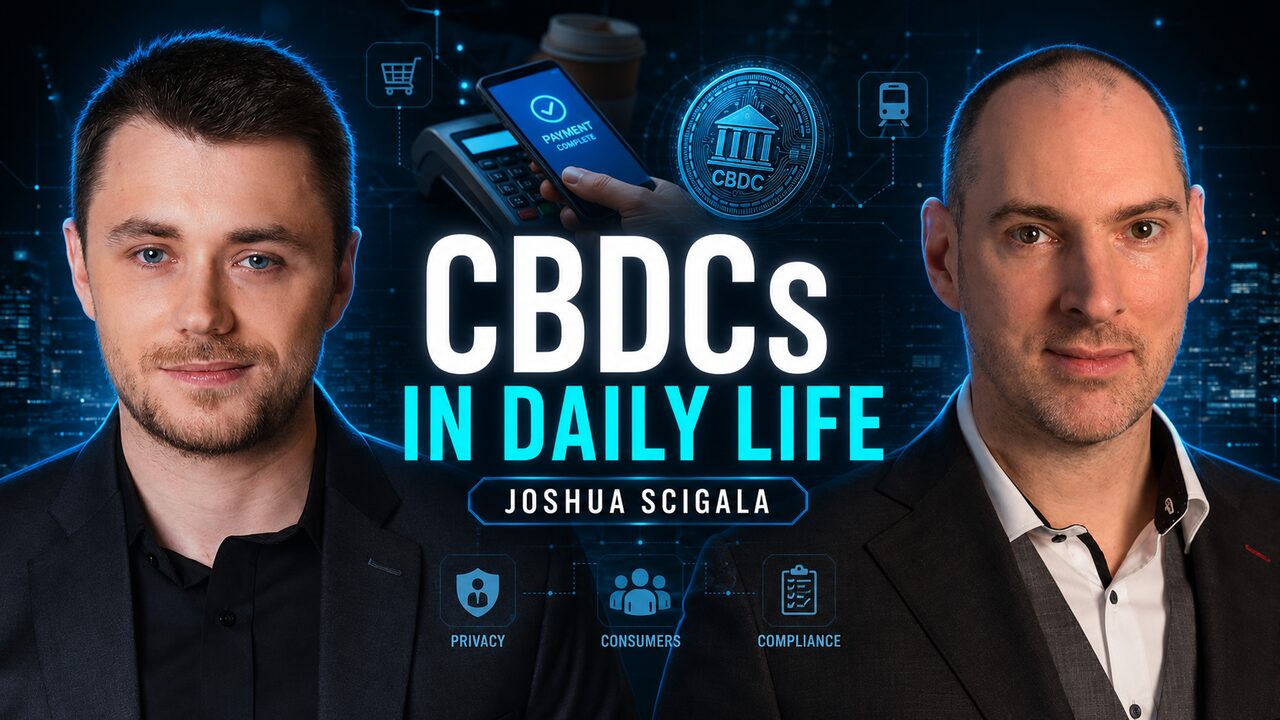
- Joshua Scigala defines CBDCs as central-bank-issued digital currencies, then argues that routing retail transactions through central infrastructure changes both payment settlement and the privacy boundary between citizens, banks and the state.
- He sees programmability as the decisive risk: the same infrastructure that can implement policy quickly could also support spending limits, geographic restrictions, account freezes or expiring balances. These are Scigala’s warnings about possible designs, not features common to every CBDC proposal.
- When Kevin Riedl asks whether democracy and existing law can constrain abuse, Scigala answers that efficiency is not enough. He prefers private-sector competition and simpler crypto wallets over creating an infrastructure that a less restrained future government could inherit.
- Scigala argues that spot Bitcoin ETFs reduce the risk of an outright political ban because influential investors now have capital at stake. At the same time, he expects regulation and KYC rules to divide crypto into investment products, compliant self-custody and a privacy-focused underground.
- His comments on property, banks, Bitcoin and Ethereum reflect a personal, time-specific view recorded before the 2024 Bitcoin halving. The episode explicitly frames the beginner guidance as not financial advice and repeatedly acknowledges market, custody and legal risk.
Why revisit CBDCs with Joshua Scigala?
Watch this part · 0:00Kevin Hi everyone, Kevin here from Wavect, and today I talk with Joshua Scigala, which is CEO of TheStandard.io, And today we will talk about CBDCs. As you might have seen on our podcast list, I talked with Joshua already about CBDCs in the past- I think like one two years ago- but this time is going to be extra exciting because, of course, a lot of things have changed in crypto. It's super fast-paced. so there are a lot of new things we have discussed and I also try to be a much more critical, so that we have kind of like a two-sided discussion around that new trend that we are going to face with central bank digital currencies, short CBDCs. So basically, we have talked about regulation. what are CBDCs, what could that mean for us as users and also how could we react to remove ourselves from that risk when CBDCs are being rolled out to the masses. So enjoy the episode. Please let us know how you liked it.
Kevin And, yeah, thank you for watching Wavect, the Web3 software company that understands what you want. Today, we will talk about CBDCs. What are CBDCs for people that have never heard of it?
What is a central bank digital currency?
Watch this part · 1:18Kevin And maybe don't even are that much familiar with crypto itself.
Joshua Well, most people need CBDCs, like a moose needs a hat rack, Like it just doesn't need it. you know, CBDCs are central bank issued digital currencies. That's, uh, it's, it's, it's fine. when you think, oh, you get real, because how they they, they spell it out as they say: well, you get real time settlement. Anyone can send any, I can, I can go to the shop and you instantly get my currency. And the big problem there is that they're not being truthful with the public. This is a fundamental change with how money is used, but not only that: how privacy around our use of money and the data is collected. So what that means is that right now, when I make a payment to you, my bank says to your bank: I'm going to give you some money at the end of the month- sorry, at the end of the day- And it calculates all of the. so basically, it keeps an IOU list until the end of the day.
Joshua And then it sends that to the central bank. So bank A owes a million dollars to bank B, which is your bank And, by the way, Bank B's got a lot of customers also send money to Bank A, So they sent their list to the central bank. So Bank B owes 200 grand, let's say, to Bank A. So the central bank says: just make one transaction- 800K- from Bank A to Bank B and that'll settle everything. It says one transaction out of all the, instead of sending billions of transactions. it's one transaction. Now the key here is isn't the speed, It's the fact that the central bank and the government didn't know what, all of what, that 800K was made up of. was it somebody's toothpaste and someone bought a car and someone did this and did that? All that data is kept from the central banks. As soon as we have a CBD, CBDC. what they say is: every transaction goes to the central bank and we decide whether that goes through or not.
Joshua Of course they'll let it through most of the time, But we saw during COVID that they had really hardcore restrictions. It's very where we're always on the on the cusp of tyrannical, you know, takeover. possibly It could be. You know, I always want to say, look, maybe it won't, Maybe we'll just have top players. but we don't want to give power-hungry people that option, because if that's options on the table, they'll take it. Or maybe we've got the perfect government, But next year someone else gets voted in. that doesn't. that isn't perfect. So it's really important not to build infrastructure on such a fundamental level that gives so much control to people. And that's kind of the deep dive of CBDCs for you.
Kevin There's. there are always multiple sides to it, right? You have banks, you have consumers like ourselves. you have companies, you have politicians like, and, of course, currency unites, some all because everyone needs it, everyone uses it to some extent. Yeah, And what you know? to understand why all these governments not do that research and try to introduce it, what would you say are one of the few main?
What intentions drive CBDC design?
Watch this part · 5:10Kevin intentions- or could be the main intentions- of people creating those CBDCs?
Joshua One second. I'm just trying to fix sound here, Sorry. could you repeat that last question? Sorry, I've got notifications coming in.
Kevin Well, in general- super short- there are multiple sides to a CBDC or, in general, currencies. And why do you think people or all these parties try to introduce CBDCs? What could be the main intentions behind all of that?
Joshua Yeah, I I'm a bit of a. I'm an optimist, but I'm also a pessimist when it comes to governments. The thing is that most people that want to head into government want control. They want, they believe that they can run your life better than you know how to There should be. you know, and a lot of people go into the government believing that they're doing good- I'm not saying that evil people head up into government, but they want to do good- but that there's this slight thing of I want to tell you how to live, because you're not living how I think the world should live. And you know, through democracy, we vote, apparently, for the right people and such, But at the end of the day, a CBDC is being brought through, because then you have total control over what can be bought, what can be sold. So if there is another massive financial crisis or there is a deflation or there's an inflation,
Joshua or there's an inflation or something like that, the central bank has far more control. For instance, let's say there's a stagflation, Things are moving very slowly, There's a bad economy. Well, what can you do? If you have a CBDC, you can say: look your money, what your intention is? to get velocity moving, to get money moving, to get you spending because that stimulates the economy. that if you go to the shop and buy things and the shopkeeper needs to get more staff, and that you know velocity of money is important. So if everyone's scared and holding, that can cause an economy crash. So what they could do is say: hmm, your money now has an expiry date, So if you don't spend it within the next 30 days, you're going to lose. we're going to take 5% of the value of your savings And everyone's like: oh what? And these things aren't just fantasy. They're being tested in certain areas, certain parts of the globe already.
Joshua It's programmable money right, So they could just go in there and do these things. And this is why decentralized finance protocols like what we're building at the standard is so important, because- and Bitcoin- let's not forget Bitcoin, I think that's the most important side of it- is Bitcoin created an exit door and front run the ideas of CBDCs, because we were heading in that direction anyway. And the thing about the world is that If you end up, your society ends up in a tyranny, meaning a really hardcore control grid of a society. it's getting harder and harder to get out of that without some sort of violence, And no society, no postmodern society, wants a violent takeover or disruption. You know we want to move through peace and have good society, to raise children and have a family, So the idea that a society can get a massive control grid means that it's almost impossible to escape tyrannies in the future.
Joshua Because tyrannies become so powerful and all-encompassing, people can't collect together, they can't organize, because everything's being surveilled, And so you know, it goes to the old joke. I asked my Chinese friend how he feels about living in China And he said: oh, I can't complain. So you know, it's Okay, gotcha, You know, and this is the sort of thing that we need to make sure, that we need to make sure that we don't hand over these tools so willingly. for what? What is the reason that governments are giving for for upgrading to a CBDC? The reason is: well then, you have real-time transfers. Okay, well, we've got that pretty much already without a CBDC. You don't need all this extra power given to the state or a central bank. The idea that a lot of people will say, well, a central bank, a government, could get the information of what my transaction was anyway.
Joshua Yes, they can, but there's a whole lot of steps and due diligence and court in between that which is important for the rule of law. If that stuff isn't there and they can just say, hmm, this month we've got an obesity epidemic, so no one's allowed to spend money on chocolate bars, or hmm, you know, I don't know, whatever you think of the green thing, of climate change and all that, maybe they think right, you've already had your ration of gas this month. You cannot spend it. Or there's a new virus- kill a virus and you're not allowed to spend money outside of your jurisdiction. Or we need a 15-minute city, Or we need, Like, the amount of control on your money. and oh, by the way, you- I don't know- walked on the pavement wrong. we're going to instantly fine you or freeze your account or whatever. And we saw tastes of this with the trucker movement during the pandemic, when the truckers
Joshua wanted to demonstrate against certain aspects of the government's decision. So all I'm saying is that, no matter if you're on the left or the right, You do not want to give an apparatus so much power. You want to make sure you say, hey, limited power, Yeah, you might be good, You guys might be good, but the next people that come along might not be, And if that power's in place it's really really hard to dismantle, Like it would be very, very hard to go back from a CBDC back to what we had now.
Kevin Quick intermission. If I could ask you for one single favor, it would be that you hit subscribe onto this channel, because it helps our job channel more than you can imagine and you know, the bigger the channel gets, the bigger the guests get. So thank you very much for watching and let's continue with the episode. You said a couple of interesting things and I'm not a fan of them myself. I'm just playing a role now, Yeah. But one could argue: CBDCs just make it more efficient, because with USDC and all these other stable coins or in general tokens, where most often some kind of organization stands behind of that, or with banks themselves, we already have that possibility. right, they already have that. they already have that. they just would need to enforce it much harder and it's less efficient to enforce it more difficult. yeah, so the question is: is that really? of course?
Kevin when you think about certain economies around the world, it is actually really reasonable that this is going to be. it's going to happen, right? I think it would be naive to say that it won't happen. but the question is, especially in the western world, as long, of course, as we have democracy. democracy: is there even a way that a central bank, even with current legacy, could do that in a reasonable fashion? of course it's more efficient from a technical perspective, but still from a legal perspective, as long as you don't have dictatorship or something like that.
Can law and democracy limit CBDC control?
Watch this part · 13:37Kevin it's actually not really possible. what's your take on that? I know you're not a lawyer and these kind of things.
Joshua but just curious about your point of view. you know, the thing about, about dictatorships and tyrannies- is that they're extremely efficient, like the trains to Auschwitz were on time, you know, because if you're not on time, that's the thing. so efficiency isn't everything. I think we should, as a society, look at how important freedom is and what we wish now, what we allow now, our children have to deal with. so think about what your children will have to put up with, and it's very. and the problem with the, the problem with freedom and having an over a long period of generations, is that you forget as a society how, how bad a bad structure can be. and when you're a tech like a very advanced civilization with a lot of technology that has a lot of surveillance, it's almost impossible to get out of that state. so, yes, efficiency is great, but let the private sector figure out the efficiencies. they, the private sector, is the best way to figure out efficiency.
Joshua the government organizations and structures are the least efficient. mostly, you know, in Germany, during, when the east and west Berlin was in existence and the wall was up, If you wanted to buy a traband, which was the only car in the in the east, you had to basically order the car when your child was born, because it took 16 years to make. So government, and this was all created by government company. So governments are just notoriously inefficient. So if we do truly want to efficiency, we want competition, and that is what cryptocurrency gives us. it gives ultimate competition. now we've got a long way to go in crypto. ux wise, it's, it's terrible. uh, y wise, it's getting better. but the, the, the, specifically the scams and everything like that, which are, by the way, only going to get worse with a lot of this AI that's that's being released to the public, where you can really
Joshua trick people very easily, which is, or be tricked and and it's very scary, specifically for elder generations, um, and, and you know, one good thing about a cbdc- to take the devil's advocate approach- would be: well, there's somebody to call if something goes wrong. um, but you know there's also strides in that where, um, different projects are building, uh, wallets. that are they. they are smart contract wallets. so, rather than having a wallet where you have to hold all the private keys, you build a smart contract that is a wallet and you could log in with and pay for gas fees in different ways. there's all sorts of ways to hide the complexities that early adopters are dealing with in crypto and uh, and make that more efficient and better without going, hey, uh, government, central bank, here, have all the power you need to absolutely, you know, decimate freedom. um, money is like you said at the beginning of this, money is the kingpin of control money.
Joshua is the, is the, is the is the is the thing that holds everything together, and so disrupting money in such a fundamental way and just simply calling it a slight upgrade is surreptitious and and we shouldn't just easily put up with it. hey guys, um, Joshua Scigala, here from the standard, I just want to remind you that we are building the ultimate borrowing platform- decentralized borrowing platform- where you can borrow against your crypto for zero percent interest, without giving up your private keys, and you can instantly take those stable coins that you meant for zero percent interest, with only 110 percent collateral, and put that into a yield account where you start to buy up cryptos like arb, like link, like bitcoin, for basically 10 percent under market price. it's a really great opportunity. um, also, just if you're checking it out, we'd love your feedback and love to hear from you in our community. thanks back to you, kevin.
Kevin I think it was Ray Dalio- uh, I hope I'm not wrong now by citing him. governments have two things: they have currency and they have weapons. if they take away the currency, they only have the weapons. and, yeah, it sounds absolutely. that's a crazy part. we see there's a similar fight with, uh- how's it called in English? the major currency worldwide, which is the U.S. dollar right now. right, every you know you have the BRICS countries, uh, countries up in asia and so on and so forth that try to replace latest U.S. dollar as the major currency for trade, and I think it's the same fight governments are fighting here, right? um, just, instead of fighting against governments, against other countries, it's more kind of let's fight about uh against technology. so that's the major issue I think blockchain is facing in general. right, you have a piece of technology that tries to remove control from the government or from central parties and, of course, these central parties.
Kevin are now in control of all that infrastructure and don't want to give it away, and that's one of the major issues, right, and I'm just wondering when, because all that infrastructure is always still in place, right, and they won't just give it away. how, since crypto is something like an exit door, as you mentioned, is that? is it really an exit door? because if
Is crypto really an exit from CBDCs?
Watch this part · 20:23Kevin austria, the U.S., China and so on and so forth say: if you used crypto, you go to prison or you can't withdraw it to your traditional cbdc anymore. uh, then crypto is still somewhat going to be worthless because people cannot or don't want to accept it like what, what's? of course, it's unlikely in democracies, but what's your take on that? you know that.
Joshua intersection between those financial systems. well, it's fascinating. we're we're at a really fascinating time where these etfs have come along and it's taken long enough, but they're now here, uh, the, the americans have green lit them, and which means that other countries will soon come online. well, now, there's two things of play. that that that happen with these, with these ETFs, is that in one way, it means that large players that have a lot of control, uh, of the, of the of the people that are in the corridors of power, um, don't want to lose money. so the people like Elizabeth Warren and and such in in the U.S. that were always very anti-crypto- which is weird because she was the one standing up at the Occupy Wall Street- you know it's really strange, but she's been really anti-Bitcoin and and cryptocurrency. the thing is, since the etf launch, there's been a noted change in her, in her vocal, uh.
Joshua at least her volume. so she's very much toned down her anti crypto rhetoric or bitcoin rhetoric there now. so that's one thing. once you get these large players, that protects you from the existential threat of, hey, we're going to shut it down. we only have two things: guns and currency. uh, you know. so this alleviates that saying that when you get laws like MiCA or regulations like MiCA out of the european union coming out, where they're stating that every transaction needs to have kyc attached to it, you start to split the entire system into two. one is the et ftf world, where that's where you buy a bitcoin if you want to store a value, that's where you go. and the wild west world where, hey, if you want to actually play, you have to be under the radar and use Monero and stuff like that. and then the third one- so there's three, sorry. the third one is: well, if you want to use it, you have to like uh k yc. I don't look into a world coin ob. I don't.
Joshua you have to do something crazy to basically move currency, to do what's actual, fundamentally a human right, which is me privately exchanging something with you without some sort of middleman, a me, me, megalomaniac, obsessed with controlling and making sure that that's a thing that's, you know, okay to do. and while there is illegal transactions and a legal things that shouldn't be done- and I agree we need a rule of law, I'm not going to say we don't. you know we want to stop things that are terrible, like child abuse or like extreme drug pushing and stuff like that, but to just do it through the control of money is the wrong way about it. we've done it for thousands of years by, by having good, old-fashioned police work and, and, yes, that's harder to do, but we, but we secure the sanctuary of, of freedom and uh and and so not to jump directly to the uh, to the easiest thing, which is
Joshua hey, let's just lock down money and control every aspect of every cent going through a wallet. so, um, so, yeah, what what I meant to say? but with that is I: I feel that we could be heading towards like a a try economy where we have, well, four, actually quad. we have the cbdc's we have in the crypto space get split into three: the uh, you know, underground, where people like, no, no, I just want to deal with monero, and then the- uh, the mika I'm going to put CBD, you know, I can't use a self-custody wallet without it having all sorts of, you know, private information about me that has to get sent with every transaction. um, and then, of course, the ETFs, which are just like, um, yeah, govcoin.
Kevin of course, what we can't do now, anyway, is: so try to show, uh, your financial institutions or your tax advice- I'm a never wallet- right, they will freak out because it's where does the money come from? and all these kind of things. so I think we're already maybe at that stage, right, where you, on one hand, can't really use these privacy coins because as a person, you then either have to fully carry- see all all the transactions anyway- and, on the other hand, if you just use blockchain, it's also even more transparent for a very long time of, even forever, like what you have done and paid for, because at some point we'll re-enter the fiat system, and that that's the main pinpoint. somewhat, in my humble opinion, it's makes it's just more efficient. right, it's, it's already here. I think blockchain is already being misused. for that, I would say, and I can't blame them for some extent as well- right, because the understanding is not.
Kevin maybe still, uh, despite all the experts talking with them, and the thing just is: what will you do? what do you think you're going to do? you? you are in crypto for much, much longer time.
How was Joshua positioning his savings and investments?
Watch this part · 27:10Kevin than myself, like: what are you going or you think you're going to do? I know there's this- will never tell anyone what you're doing with your money, but what are your tendencies like? I don't think you're all in in in crypto, because you usually
Joshua can't be. but what's your strategy? well, don't have, only have what you can afford to lose in a bank. you know they used to say that about crypto. but um, where we're? we're heading into a time now where there's a lot of cover-ups. I mean, just look through the whole covid time. during the cover time, we had grounded airplanes across the world, yet yet, uh, airline stocks were, were skyrocketing up. if this doesn't say to some, to everybody, that the stock isn't, uh, you know, some sort of facade, then I don't know what is. that's not to say that they can constantly control the stock market. obviously, there's a lot of, lot of capital of play. it can move, it can think, things can happen. it's not upset, uh, totally controlled, but there is, there is a control vector there. when it comes to what. what I'm doing personally is that I think, first of all, you, you, you, you want to try to think about what will happen in the future, in.
Joshua terms of jobs, in terms of security. you don't want to go full prepper, but I think just thinking about where to place money is important. now, no matter what technology is being used as money, property and being somewhere where you can live is always going to be valuable. of course, um, it depends where, because if you're in a country where property rights aren't very strong or you know- and this happens actually a lot in in, in more developing countries, where I don't know, the president's brother is in charge of the database of who owns what and all of a sudden he changed, you know, logs in and goes: oh you, you don't own that anymore. so you have to make sure you're living in a place that does take property of rights correctly, uh, but if you live in a place that does, uh, has good property rights track record, then buying land or a house or somewhere to live is always good because there's always people.
Joshua that want to, that everyone has to live somewhere. um, the only time that gets truly decimated is during war. um, so, if you did want to, if you're thinking that you are closer to, uh, somewhere that could be exposed to that, then maybe think about moving somewhere more peaceful. in terms of crypto, we are right now in the perfect storm. we're heading toward a halving. BlackRock itself, the etf- there's nine ETFs out of the U.S., I think, or 11 or something like that. BlackRock is one of them. just one buys, on average, about 10 000 bitcoin a day. now, every day, the miners release about 900 bitcoin, only 900, and after the halving, which is about 50 days time, um, that's going down to 450. these, these, these, these, these large etfs will find it very, very difficult to find new bitcoin for sale. um, what will, what will? what I believe will happen, and and maybe, maybe I'll be quoted on this- but one of these big, big, big ETFs, the boss will be breathing down.
Joshua attack. I need 10 000 bitcoin now and the the guy is like trying to source these. where do I find these 10 000 bitcoin? like I can't find it, but Coinbase doesn't have no one's selling and and they'll, they'll, they'll start to go to sketchier and sketchier parts of the internet to try and get this and then they'll be scammed. one of these big ETFs will be scammed and what will happen then is that they'll cover all this up, just like banks get. banks get scammed all the time. banks get hacked all the time. they just you never hear about it because they cover it up. they don't want that public. they've got a very structured PR. but so what will happen? you won't hear about it, but they will get scammed out of billions of dollars because they'll head, they'll try to, you know, get bitcoin that they couldn't get, so then they'll head back to only using Coinbase and stuff like that. so what happens then? to release diamond hand bitcoins?
Joshua meaning bitcoins that are just no one's letting go of those. they're just going to have to offer more and more and more money for them. and so people don't quite understand how rare bitcoin is: 21 million, it's 21 million divided by everything. and so hold on to those bitcoin, because after this halving, um, it's, it's, it's going, it's going places. and you know, El Salvador, jump the gun, because now it where the bitcoin. you know, normal, normal technology usually has an up uptake from from the up to the down. so meaning, usually the vc's find some clever people in silicon valley, they'll invest in them and then their friends will invest and they'll see, oh, that that's doing really well, invest and and the big, the big family offices will invest, and then it'll get publicly listed where the investment banks can also have a go and eventually the plebs will get to buy a few shares. bitcoin was the very, very first technology where it was the other.
Joshua way around: the, the crazy anarchist types- oh, oh, what's this bitcoin thing? and then the libertarians and the, and the technocrats, and and, and then, eventually, the moon boys, and then, you know, the lawyers, and then the vCs came along, and then the family officers, and then the investment bankers, and now we're at the ETF stage, and after that comes the countries. so it's, it's the other way around. and you know, El Salvador jumped the gun, beating the ETFs, but next up is the countries. uh, because what will happen is el salvador will be able to easily pay off all its iMF debts and and everything else, and other countries will go, wow, that was a good idea, I might do the same. and um, and we'll have a crash before then, and uh, but you know, so it's, it's, it's the constant building, bus cycles, but yeah, um, I don't know, I, I I'm not really answering your question there- but uh, it's, it's a crazy, crazy.
Joshua world that we're currently working through and living through, and um, you add to that the job losses that are coming due to AI and uh, and even if it's not just job losses, maybe there's new jobs gained, but the shift I should say in the economy, in the economy, is going to be huge. so we need to, um, you need to think very, very carefully about what to do with your savings and how you structure your family's plan for the financial future. that's, that was no, I think, a great ending, uh.
Kevin really, um, all all I can say is like it's definitely crazy where we are going, where we are heading right.
Joshua and I think that's. I have nothing to add, let's put it that way. well, I mean I, I I do want to tell people a little bit about the standard, just because we're just about to relaunch that. and uh, for those that don't know, we've been building a stable coin protocol and borrowing protocol. basically, we've been building a protocol that lets people borrow at zero percent interest without giving up your private keys, so you're not trusting a third party like celsius or blockfi or ftx. you can lock up crypto in a, in a smart contract that you control the private keys to, and then you can issue yourself for zero percent interest, and we're releasing these yield accounts. so when you lock up, you can already do this in DeFi. right, you can lock up and borrow, but what's what we do specifically differently is that you can lock up an entire portfolio into one smart contract, wallet and um- and, if you feel,
Joshua like, oh, this coin's going to do well or that kind of coin is not going to do well. you can continually trade your locked collateral, even though you've borrowed against it, and every time there's a a trading fee, that happens, that gets put into a pool and anybody staking in the yield accounts the euro s or the tst or- and the tst they can buy- they automatically buy all of the crypto at 9.91 percent under under spot, under, you know, market value. so there'll be bitcoin, there'll be ethereum, there'll be link, there'll be Arbitrum. all of this stuff will automatically be bought at 9.9.91, basically 10% under market value, and you can then claim that and go and sell it for for that, for that bonus, for that arbitrage, and and so this is, this is, this is going to be absolutely massive, because what we're doing now is we're taking away power from the banks where we can say: look, we don't need your.
Joshua interest-bearing accounts why, like I, I don't actually have a problem with interest. for instance, if I lend you money, kevin, there's an opportunity cost for me. I could be doing something else with that money. I could, you know, I could be building a house. I could do something else. so I think, morally speaking, there's nothing wrong with interest if I, if I have some currency and I lend it to you. where I have a problem with is with central banks creating money out of nowhere and charging interest for it, or protocols in DeFi that like MakerDAO or um, you know, any sort of DeFi where they're making, where they're generating, minting new, stable coins, and then charging you a stability fee or interest fee for it. I think that's just, it's not right. um, so we've really focused on zero percent interest, 110 percent collateral, and that's an actual collateral if you go to liquidity or something like that.
Joshua they say it's 110, but they have these automated redemption things that can just redeem you, uh, even though you've got 180 percent collateral, they, if the peg happens too quickly, um, they can just redeem you. so this isn't good. so we're we're really structuring, we're about to relaunch um where, uh, probably next week, we're going to do all of this. so come and check us out. um, we're also, if you go on to, because there was a, there was a, there was a slight deep peg in the euro s while we've been fixing some stuff up. we haven't bothered fixing it yet because, hey, you can pay off your debt cheaper if it's depeg for now, um, and so right now, you can go and pick yourself up some euro s- that's just under a euro- and uh, and wait for the repeg, which should happen next week, um, so it's very, very exciting while and we're releasing these, uh, these, uh, these uh yield pools, which would be fantastic because um of the opportunity that I that I mentioned.
Joshua before. of course, this is all very advanced stuff. so if you're just getting into crypto, don't do.
What should crypto beginners consider?
Watch this part · 39:00Joshua any of this stuff. ignore everything. I just said: go and buy stuff, some bitcoin maybe. uh, not financial advice, but you know, if you're new to this, stick with bitcoin, stick with ethereum and that's all. don't buy anything else. um, if you're more advanced and you like some of the DeFi stuff, that's.
Kevin happening. uh, definitely check out TheStandard.io. uh, awesome. thanks very much, mate. uh was a pleasure.
Joshua talking with you. and yeah, thanks a lot, kevin, it's really. it's my pleasure to be on the show.
Kevin I hope you liked the episode. Anastasia was like shocked about the things Joshua said during the interview, so I'm really grateful to have him on uh second time. and yeah, please, as always, leave your feedback below and, if you could, please hit subscribe to this channel. it really helps us. and yeah, thank you for watching Wavect, the Web3 software company that understands what you want.
Questions this episode answers
Want this kind of thinking applied to your product?
We build MVPs and act as fractional CTOs for founders who'd rather ship than talk.