VCs in Blockchain: How to Benefit During Crypto Winter
James Wo Founder & CEO, DFG · $1B+ AUM
James Wo founded Digital Finance Group in 2015 and grew it past $1B in assets under management. A conversation, recorded mid crypto winter, about how investors and builders survive the down cycle.
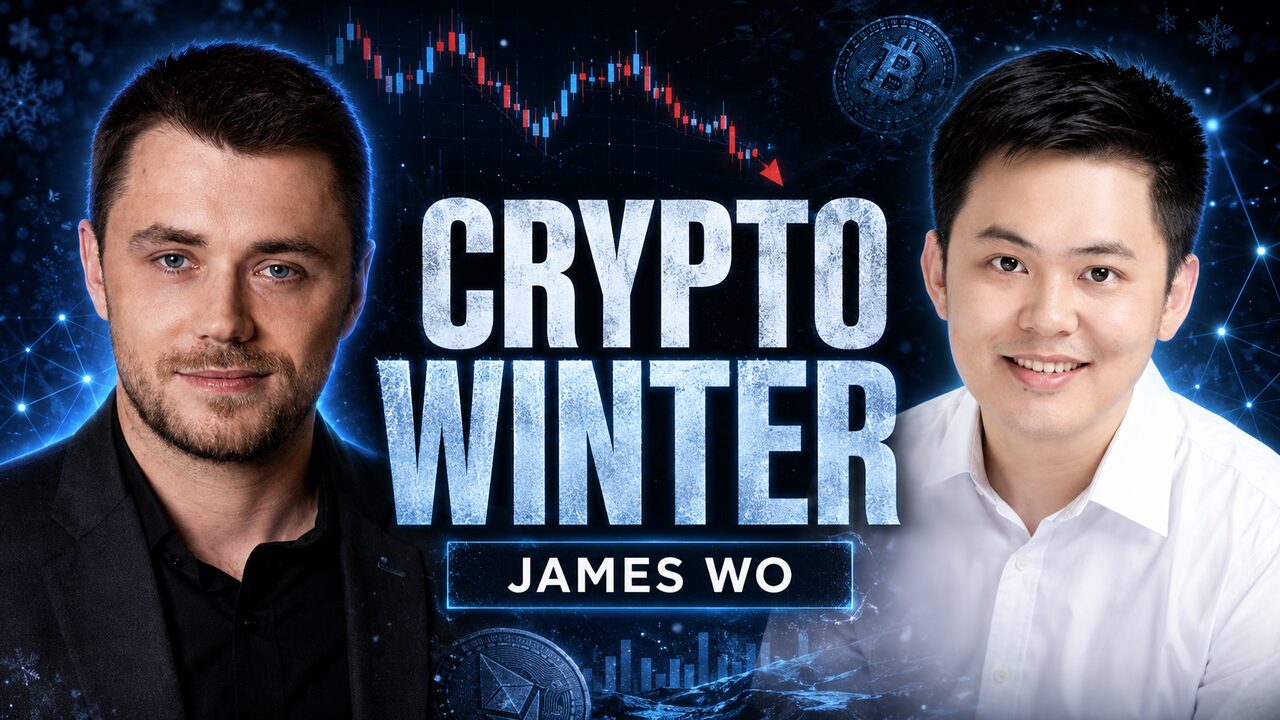
- James Wo says the collapses of FTX, 3AC and Terra made VCs far more cautious. His investment firm DFG went from roughly two deals a week in the bull run to one or two a month, but with bigger ticket sizes, more involvement and better terms.
- Self-custody comes first. James Wo’s number one rule for the crypto winter is to own your private key, because “it’s not your key, not your money.”
- Do your own due diligence instead of following big names. James Wo points out that even big-brand investors failed in the market, citing FTX, 3AC, Terra and the Solana bets that followed them.
- DFG backs builders who commit to one project for the long term, like LedgerX and Polkadot. Founders who multi-task across projects or are loud and noisy on Twitter are red flags for the investment firm.
- Cash flow rules in a bear market. James Wo advises startups to raise enough for roughly two years of runway, even at more dilution, because nobody knows how long the crypto winter lasts.
Who is James Wo and how did DFG start investing in crypto?
Watch this part · 0:00Kevin Hi everyone, welcome at Wavect. Today with James Wo, who is the founder of several companies such as Jsquare, Digital Finance Group, Matrix Exchange and Ethereum Classic Labs. And today, as you might already guess, we will talk about VCs in blockchain and how to benefit during the crypto winter. First of all, thanks James for being here, it's really a pleasure talking with you. And starting out, I would like to give you the opportunity to tell us whatever you want, like what are you working on, how does your regular day look like. And yeah, feel free to drop any nuggets, if you want to.
James Thank you, Kevin. Hello, everyone. This is James Wo from DFG and Jsquare. So basically, we are a crypto investor in the industry for the past seven years. I started DFG back in 2015. Unlike the other VCs, we, you know, my family gave me a lot of support, so we don't raise any outside LPs, so it's 100% our own capital. It's more like a private company. So we invested into a bunch of startups first, including companies like Circle. So, you know, because 2015, 2016 is pretty early stage in crypto, mostly we invested into different exchanges and also the Bitcoin use cases. During the bottom of 2017 and after 2018, we started to invest more on the layer one side, because we realized, you know, there are so many applications built on Ethereum and stuff from 2017. We realized that, you know, Bitcoin itself, only Bitcoin is not just enough. So we're seeing the other layer ones, you know, definitely have room to grow in the future. So we decided to invest into a lot of big ones in the early stages, like Polkadot, like NEAR and a few others. We think this kind of infrastructure is very, very important to the crypto industry. So we definitely, you know, keep a close eye on the investment in, whether that's a layer one protocol or other, you know, centralized solution providing infrastructure.
James The other part of what we do investments is more applications. During the last bull run we invested in a pretty diversified way in different sectors, like DeFi, NFT, metaverse, GameFi and a few others. So overall speaking, DFG currently manages somewhere around a billion dollars with all different kinds of tokens and [unclear]. And there's another fund called Jsquare, which is a very new fund established last year by myself and my friend and colleague Jirana. She was actually, you know, in Huobi in the past few years, then she joined DFG in 2019 and was working for us, you know, in the past three years. And last year she decided to leave and we started a new product called Jsquare. That fund is slightly smaller, it's 150 million dollars, focused more on the early stage investment and the innovation applications. So that's where we are right now.
Are layer 2 solutions the answer to blockchain scalability?
Watch this part · 3:23Kevin Wow, very interesting. You said you invested on the infrastructure side, mostly in L1s. What do you think, if I might ask it now, about layer 2 solutions and that kind of infrastructure? What's your opinion about that?
James Yeah, I would say that's super important, right? So, you know, for the infrastructure or the protocol side, the scalability issue is really the key issue from the very beginning of the industry, right? So in 2017, during the bottom, people realized, you know, most of the applications, to be honest, don't need that kind of really high TPS, but there's a certain amount of applications that definitely need that. So in 2017, we realized, you know, [unclear], so we realized we have to solve this scalability, right? So in 2017 there's a bunch of waves about hard fork, right? You got a bunch of, you know, Bitcoin hard forks and [unclear], and then we have other layer ones trying to solve certain, you know, scalability issues, right? But at least so far, this kind of hard fork solutions proved to be not working anymore.
James So during the last bull run, there's two kinds of ways to solve the issue. The first is trying to build layer two solutions in their, you know, in an online network. So that's definitely a very realistic way to solve the problem. The other is the other, you know, potential solutions, right? So there's a whole new ecosystem trying to use a new solution to solve some problem, right? But at least so far, I guess, you know, Ethereum is still a dominant market after most of the developers and projects built on top of it. So definitely, something, you know, Ethereum plus layer two solutions will be kind of the mainstream solution to solve the scalability issues in the near future. That's my prediction right now.
Why bet on L1s like Polkadot and NEAR instead of layer 2s?
Watch this part · 5:20Kevin Okay, interesting. So from your investment standpoint, were there a couple of things that you would like to see in the future, a particular reason why you preferred old L1s instead of, let's say, layer 2 solutions?
James Yes, I think because the ones we invest in, the layer ones, they are not just solving the scalability issues. They are more like, you know, for example, Polkadot, they are not just like solving this part of the problem, and the other problem is about cross-chain, right? So you have all these kinds of protocols, it coexists together for the long time, you have to find out the cross-chain solution which is secure, with all the bridges being hacked during the last bull run. It's almost proved that the bridge is the wrong business model, so it's not going to work. And, you know, but finding out the solution like that, like Cosmos, Polkadot, is definitely important for the project. So that's the other part of the question, of the problem, in the protocol space that we invest. And NEAR is also the one we invested, it's also a different solution, it's about sharding, right? So, you know, it's also different than what exists right now.
James So that's the reason why, you know, I'm not saying solutions like Avalanche and Solana, they don't have room to grow, which, you know, they do have a chance to succeed, but it would be very hard, because they are trying to directly compete with Ethereum plus layer two. So basically they, you know, they are trying to solve the same problem. But speaking of, like, the other solutions, like Cosmos and Polkadot, they are working on a whole different kind of scope, which makes that not directly competing with each other, which also, you know, have their own potential to grow in the future, because they are definitely solving the...
Kevin Hey, fully agree. It's always better to not directly compete with, let's say, a company or at least a solution that's already out there in the market and widely used, because you always need to be much, much better to actually overcome that barrier and, you know, grow past that.
How would you define the crypto winter?
Watch this part · 7:23Kevin Well, that's super interesting. Thanks for these insights, James. As you mentioned before, we had now several bear markets in crypto. I would also state now that we have, due to the macroeconomic situation plus all that happened in the last couple of months or last year, one of the more, let's say, harsh crypto winters. But please disagree with me if that's not the case. How would you define it to someone who has never heard of it, just to get everyone on the same page in the very beginning, and then we will dive deeper into it?
James You know, you see all the collapses of FTX, 3AC, Terra. They are causing definite negative impact on the retail investment and also the institutional investors. You know, people are being more cautious these days, because, you know, these kinds of solutions, I mean, I want to say they are overvalued during the bull market. Because, you know, they have, you know, kind of trying to use leverage, or like for Terra, they have small supply, then push the valuation to very, very high, then create a bubble for that. And then, you know, once their business, the business model itself cannot last for long, right? So if you over-leverage for the investor, or if you are creating 20% yield for US dollar, that's not going to last long. And if you're moving people's money for them, like FTX, that's not going to last, end up doing well. So this is probably the worst, it's causing really big problems.
Is the bear market actually a chance for investors?
Watch this part · 9:22James I think so far, during the bear market, I think, you know, we see more, like, chance. We will see more chance in the bear market. Because right now, in the last two bull markets [unclear], we see the application is very, very simple. It's just like, it's there and there, and then you build a bunch of [unclear] on top of that, that's 2017. In 2014 [unclear], that's even easier, just before. So right now we got a very, very complicated or diversified kind of crypto market, with all the people participating in that. You know, during the last bull run, you basically have all the industries, like DeFi, GameFi, metaverse, that reach out to every part of the traditional industry, in the financial system, in the gaming industry, all of that.
James So everyone starts to know about the crypto, and a lot of people are actually participating in the crypto industry. So probably like 4 to 5% of people own Bitcoin or crypto so far. So I guess, you know, for the next bull run, then we will have... It could be the last chance for us to really get into Bitcoin or Ethereum at a very, very cheap price. And for the next bull run, then we have billions of people kind of holding crypto, then that's it, it's pretty much like the internet. And, you know, that's why I think the bear market so far is actually... It's also the overall policy being slightly aggressive. I would say they're being slightly aggressive and push the price to lower. So I think that's actually a good opportunity for investors, whether institutional investors or retail investors, to buy Bitcoin, to buy ETH, to get a chance to move into the crypto industry at a very low price. So that's even more like a chance than, you know, worry too much about it.
How have VCs been impacted by the FTX collapse?
Watch this part · 11:24Kevin Yeah, fully agree with that. And you just talked about FTX and basically also the investment industry, the funding industry. How do you think, or what's your, let's say, viewpoint on how VCs in general have been impacted by all of this?
James Sure. I think it would be largely impacted, you know, several reasons. One is that VCs, they have exposure to the FTX, that's directly impacted, and that's the first. The second is really, a lot of VCs follow the investment of FTX, they invest heavily into the Solana ecosystem, they take a really big setback. And even if you have zero exposure to the Solana ecosystem, you have zero exposure to FTX, people like us, we don't have exposure to that, and we do invest into Solana projects, but that's really two, three of them, very small check size, but we also be impacted. Because the price of the market goes down, right? So we indirectly also being impacted by the FTX situation.
James So I think VCs right now are being very, very cautious. People like us, like, you know, we invested into probably two projects a week in the bull run. Right now we invest into probably one to two projects at most, probably, a month in the bear market. Because we've been more cautious. Why should I do all this kind of investment? And most of them are very, very risky, right? But on the other hand, we think we are being more aggressive, because we're trying to drive much bigger ticket size and trying to get more involvement in this kind of project. Of course, in the bull market, there's not a lot of room for negotiation. Then, you know, whatever, you know, if it's a good project, then we're asking for allocation, then we get in. There's not a lot of room for negotiation. Right now we can negotiate for a better term, and we can probably, you know, select the projects we want to invest. In the bull run, maybe investing into something else, we can do some project, some product with a crazy valuation, we also invest. But right now we are definitely not going to do that. We will see the product, see the team, and see why we're actually investing in you guys. So it's actually better, if VCs still have money, or still have a lot of money or part of the money on their balance sheet, it's actually a good time for them to get into these projects with a better term, if they can make good selections.
How does DFG select projects and founders to invest in?
Watch this part · 13:45Kevin Speaking of selections, that was really interesting. How would you, besides the team and what you just said, actually select a good company to invest in? What are some of your criteria, for example?
James Yeah, I think if we calculate, you know, all the projects we've invested in before, really the ones that gave us the real return, or really the meaningful return, is the ones who are building for the long term, right? For example, we invested in LedgerX in 2017, we cashed out and sold that to FTX last year. It was not a crazy return, but still a very, very good kind of return for us. Because, I mean, these guys are building the product for the long term. And also for Polkadot as well, we invested in 2017, 2018, 2019, 2020, and Gavin Wood and his team are also building this for the long term. So it's actually, you know, it's actually good to take a strategy of selecting the builders which can insist on working on a project for the long term. So I saw there's a few kind of builders, they're trying to kind of start multiple projects at the same time, or shifting the project quickly. If this one fails, they're moving to other industry, moving to other ecosystem and then starting a new project. That's not going to work well in the long term. So that's one important factor when we decide to select a project when we invest.
Kevin Okay, that's interesting. Speaking of somewhat personalities, what are the personalities of founders? Thinking long term or being in for the long term. Are there some other traits that you're looking for in founders?
James Yes. I mean, the track record is definitely important, right? So, and, you know, this is something you can track. If this guy already has done something like this, then definitely don't invest into it. The second is really about their personality and about, you know, whether this guy is down to earth and keeps, you know, doing the business. I don't like the guys who are being very, you know, very crazy or noisy on Twitter. I don't think that's a good thing. You know, 3AC, Terra, you know, SBF, these guys are all crazy and very kind of active and noisy on Twitter, and they all fail, right? So, I mean, Vitalik does post some kind of articles, but it's very tech oriented. You know, Gavin would never, almost never, barely use Twitter, you know. I mean, I'm not saying using Twitter is a bad thing, but what I'm trying to explain here is, like, trying to probably do more things down to earth instead of just doing a lot of marketing stuff, and trying to not, you know, do crazy marketing stuff. That other people don't know about it is actually probably a bad strategy for the project in the long term. And also, for example, it will add a lot of chance for us to invest.
Why is over-marketing a red flag for investors?
Watch this part · 16:46Kevin Interesting. Do you mean because the focus shifts from actually building towards marketing? Or what are your thought models behind that? Or is it more the mindset?
James Yeah. What I'm saying is, you know, because usually if you do over-marketing, then it first costs you a lot of money, right? The second is really, probably, you know, people will know about it, then it's probably overvalued, because you are doing over-marketing, right? So if you, from a purely investment perspective, you want to select something that's undervalued, right? Something that is not doing marketing then, but the product is very solid, because eventually people will use it, people will get it, right? So I think, you know, especially in the crypto space, it's very noisy. You know, you will see all kinds of things. A lot of people don't even know much about it, and they heard of, like, okay, SBF buying Solana, I'm buying Solana at $200. Then you lose a lot of money, right? So that's the situation here. So from an investment perspective, I really suggest people to be very cautious and dig in further about technology and product first. And if it's a layer one infrastructure, dig into the technology more. If it's applications or whatever, DApps or whatever, then dig into the product more and see whether that has value, instead of just buying, you know, I heard of them, they have big name, big brand, that's going to invest. I think that's definitely the right way. So, I'll show you here.
Kevin Okay. So basically that's something projects shouldn't do, from my understanding, at least from your investment perspective. Are there some other, let's say, red flags or things that you would not invest into if you see that in a fund or in a project? Don't do that.
James Yeah. I think multi-tasking is definitely, what I mentioned before. The second is really still, I mean, it depends on a bad track record, right? So if the guys, who were trying to, you know, in the previous days, they're trying to blow off their investors or people who buy the token on the secondary market or whatever. I mean, that's not a good thing. I heard some of the projects, they are trying to, they are very, very tricky. I mean, most of them are good, but few of them, you know, they're trying to prove very tricky things, they are a lot of investment. For example, investing into [unclear] but didn't give the investors tokens or something like that. That's pretty bad. You know, these kinds of things we are definitely going to avoid, or trying to say this is a red flag. You know, the other things, I mean, we are keeping it more flexible. You know, as long as you are a good team building the right product, whichever, you know, angle to move in the industry, then we would definitely consider it.
Kevin Okay. Yeah, thank you for being so open about that. That's usually something you tend to not share, because, you know.
Which deal terms protect VC investments in a bear market?
Watch this part · 19:58Kevin To change perspective now, back to the VC itself. When negotiating terms, which is, as I mentioned, now easier in bear markets, are there some, I know that goes into detail right now, but are there some terms that you try to get into a deal right now to secure or reduce the risk of your investment?
James Yeah. I think, you know, about negotiating terms, there's two things. The first is the amount they raise, the second is valuation, right? So, I mean, from the valuation perspective, it's definitely being much more reasonable right now. But we also care a lot about the amount they want to raise, because cash flow is super important in the bear market. Nobody knows how long we're in the bear market. I mean, I predict next year we will have a better overall environment, but nobody knows. Maybe next year it's still the bear market, right? Then you have to prepare at least probably two years of runway to make sure the projects are there, right? So, of course, I mean, for the previous projects we invested, some of them are really decent projects, but they are short of cash. We'll definitely give them some support and also introduce them to other good VCs to give some support. That's definitely something we want to save and make sure they're surviving the winters. The other thing is really, with new investments we'll be more cautious. We invest more on the mainstream kind of projects. And of course that gives us more safety and certainty that, you know, they are not going to, you know, die in the bear market, since they are, you know, they are big enough and we invest into a lot of money, then they will definitely survive. For a small project, you know, we are also asking them to, you can dilute a little bit more, but you've got to make sure you have enough cash to survive the crypto winter. Otherwise it's very, very risky for VCs to invest.
Kevin Okay. Yeah, thank you.
What are James Wo's three key takeaways for founders and VCs?
Watch this part · 22:00Kevin James, do you maybe have, let's say, three key takeaways for either founders or VCs watching this, that would maybe summarize the whole podcast right now? Or let's say some of the most important aspects of it.
James Yeah, sure. The first is definitely, you know, I would say the first is own your private key. Yeah, and being self-custody. And that's probably the number one important thing. Otherwise, you know, I'm not saying all the centralized platforms are bad, but it's still risky, right? It's not your key, not your money. The second is really about doing due diligence by yourself. And it's really important about not following these kinds of big names. I don't like that strategy, you know. For example, it doesn't mean that the big brands have good returns, you know. And also, you know, we can see all these kinds of big players fail in the market. So definitely do your own research, do your own due diligence instead of following others. The last I would say is, be more brave, you know, in a bear market. Because I feel like people are being, you know, too aggressive in the bull market and too cautious in the bear market. So for the people who are being too cautious, just be more brave in the bear market. Since [unclear] in the next few years, we still have a very bright future for the crypto industry.
Kevin Love it. Hey, thanks, James. From my point of view, I learned a lot. Thank you for coming on to this show. And I would say, anything else you want to drop here about your company, about your projects, please feel free to do so. Otherwise, I will put all of James' links into the video description. And yeah, I would say thank you, thank you, thank you for being here. And yeah, talk soon.
James Thank you, Kevin.
Questions this episode answers
Want this kind of thinking applied to your product?
We build MVPs and act as fractional CTOs for founders who'd rather ship than talk.