Is the Metaverse Dead?
Christoph Sitar Owner & CEO, MEDIASQUAD
Christoph Sitar owns MEDIASQUAD, an award-winning XR studio in Tirol building multi-user mixed-reality experiences. A conversation about what survived the metaverse hype, and where AR and VR actually deliver.
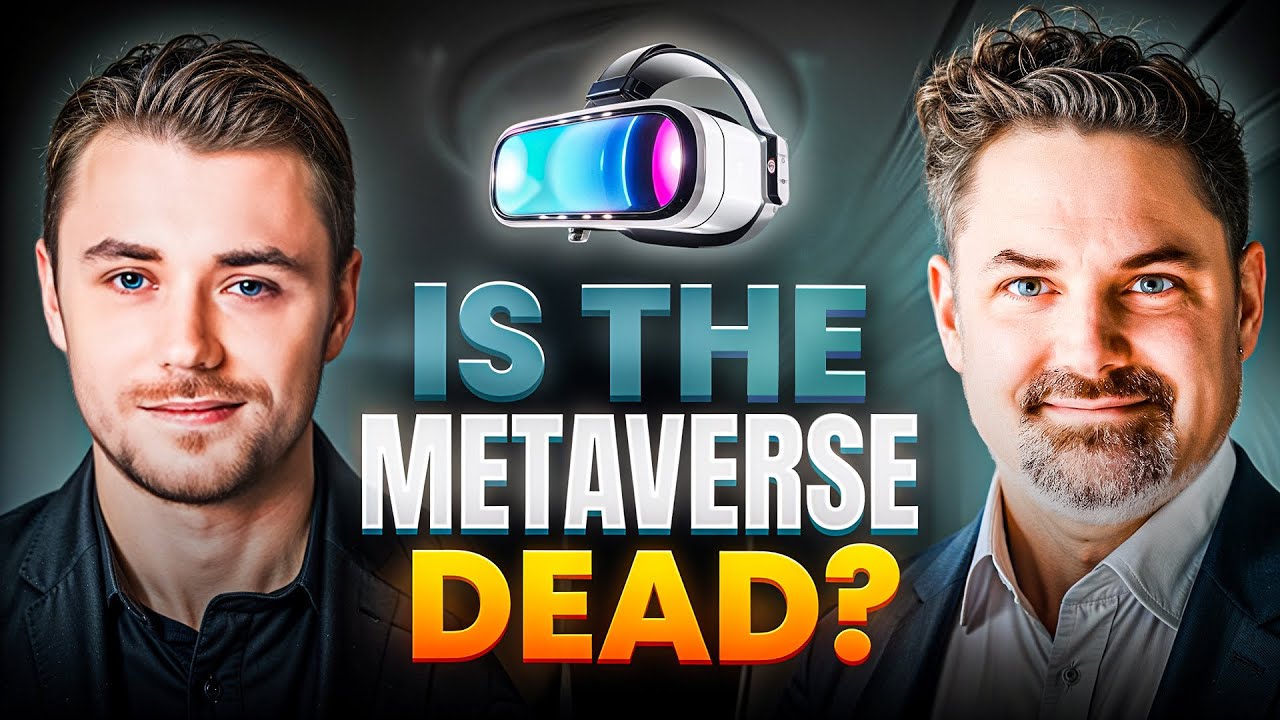
- Christoph Sitar, Owner and CEO of MEDIASQUAD, declares the original metaverse vision dead: one interconnected Ready Player One world is not going to happen. Like the early internet, the metaverse is evolving into a base layer for many virtual worlds, not a single destination.
- Presence beats photorealism. MEDIASQUAD’s framework, built on Meta’s Shared Spatial Anchors, uses abstract robot avatars with accurately tracked hands, and Sitar reports users fist-bumping and high-fiving people who are not physically in the room.
- According to Sitar, hand tracking was the breakthrough for non-gamers: people can grab, push buttons, and interact the way they expect without learning a controller first.
- Sitar calls Zuckerberg’s holographic glasses demo close to an iPhone moment, but only if the hardware ships in roughly two years at a price around 1,500 dollars; the iPhone, he notes, launched as a finished consumer product.
- Both Sitar and Kevin see data privacy as the unsolved problem of always-on cameras and room labeling, from profiling and ad targeting to insurance pricing. Sitar wants policymakers to regulate before it becomes an issue, without stifling innovation.
Is the Metaverse Dead?
Watch this part · 0:00Kevin Everyone, welcome at Wavect. Today we're gonna talk with Christoph Sitar. He's the owner of MEDIASQUAD, an XR, VR, AR software agency, and they're doing crazy stuff, really. They've won a lot of awards for what they're doing, and they do it incredibly well. So I'm really pleased to have Christoph on today, and we're gonna talk about all sorts of things, from data privacy issues when it comes to mixed reality, or all the innovations that are happening right now in the space, like all the new headsets and everything that's coming up right now, and business use cases and everything. Really, stay tuned, it's really exciting, and Ernesto can't wait anymore. So let's dive in. Is the metaverse dead?
Christoph Well, you're asking me as a VR enthusiast, so I'd say no, it's not dead. It definitely changed. When it first was coined, when Meta, now Meta, was made from being Facebook, then I think people were thinking about this interconnected Ready Player One world. They were thinking we would all live in there, we would not do any Teams calls anymore, maybe we wouldn't even love and kiss in the real world anymore, everything would be virtual. The metaverse is definitely not that. So it kind of evolved. There's a lot of work being done in the background ever since that point. People, companies are putting together base layers on what it means to create interconnected virtual worlds. There's also the metaverse where virtual content gets injected into our everyday lives, in terms of mixed reality, content being part of our actual reality but enhancing it. Can be easy things like directions in cars, can be complex things like sharing virtual content between a couple of people who have those glasses on.
Christoph Most likely everybody has seen the Apple Vision Pro. I've seen the Meta Quest 3, those VR glasses that are really good at actually showing your physical world, but then putting some augmentations in there, and then connecting people. For example, you being far away, you have the glasses on, me being here, my friend standing right next to me here, and we all share that same virtual content between us, and can even give interactive stuff to each other over the distance or right there. So to answer the question, I think the first vision of a metaverse, this one world where everybody dives in, I think that is not going to happen. Like with the internet back in the day, it never was just one website. It was a base layer, a protocol that enables people to create multiple websites, multiple verses in the metaverse. So I think it evolved, and I think it's getting slowly into a place where it's going to be usable for a majority of people in the very near future.
Is the Social Metaverse a Thing?
Watch this part · 3:55Kevin Very interesting take. So from my understanding, you don't really believe that the social aspect of the metaverse, that social metaverse, as people call it, is going to be something, or a thing?
Christoph Again, not in the same way as it was advertised. I mean, I spent myself a lot of time... Because I'm 42, I have two kids, and I don't have that much time. So when I want to play Dungeons and Dragons, all the peers that I used to play with, nobody has time anymore, they also have kids. So I delve into, for example, Demeo. I play with other people in this small multiplayer game, but that could also be kind of like a social metaverse. I spent a lot of time in Altspace during COVID, and it was still a thing, was acquired by Microsoft and then silently, well, snuffed out. But I really enjoyed that aspect. I really like to mingle with people, like the conversations I had there. And I think that is definitely going to be something in the future, but it has to offer some kind of consistency. You have to have your own persona between multiple worlds, and before that base layer is established in a meaningful way... I think NFTs could be the base layer, on a technical point of view, for having my own persona and stats rendered into the game, and that persona then being used in different kinds of metaverses. So I think that's going to be a thing.
Christoph What I also saw is things like Fortnite exploding. They have really famous acts playing concerts in there, people, crowds cheering through it. I've seen Roblox really getting traction. It's so interesting, it's so amazing. I don't think it's for my generation, 40 plus, you know, definitely not a lot of people delve into that. But my friend's kid, 12 years old now, he's all into the Gorilla Tag, into the Roblox, into the Fortnite, and for them it is very much a reality, spending time with your friends on the actual basketball court or spending it chasing each other in a Gorilla Tag session.
Kevin Interesting. Yeah, well, as you said yourself, it's definitely going to be a generational thing, right? People spend their time differently depending on the generation.
Christoph Like, as the metaverse, I think there's also a need for our generation, but it has to be kind of different. I think you already tried the Apple Vision Pro and that Personas feature, right? Where first you scan your head, and then Apple creates automatically this physical persona of yourself, and then you put it on an avatar. And because Apple tracks your facial patterns, it tracks your eyes, basically the person that you interact with has kind of like a hologram, a little bit like Star Wars, only a little bit better, but then also not, it's not there yet. But they have a little hologram of you sitting right next to them. And that is something... Think of families living far apart. Think of the United States, everybody moves around all the time. Having your mom, having your grandma in the place where you can actually look them in the eye, where you can actually talk to them, not via video call, but via something that feels more realistic. I think that is going to be definitely something also for the older generation.
Is Mixed Reality just the Start?
Watch this part · 8:00Kevin A very interesting point. Could it be, and that's maybe food for thought, that what you just described, for example that use case, okay, family quite apart, that this could be an intermediary solution? And one possibility of where we might end up is where we actually have something like really human-like things in the real world that people on the other end of the world can actually, in real time, you know, move, and these kinds of things. I'm just thinking really abstract here and trying to make sense, because from a use case perspective you said, okay, well, I have people I love next to me, right? And of course, if they're actually here, in some sense I can touch them, that's different, right? So it's actually better, maybe. So, just a very thought-provoking...
Christoph Okay, I have a couple of thoughts on that, actually, also from what we did over the last couple of months. For your viewers, for your listeners: we developed, based on a technology from Meta called Shared Spatial Anchors, basically we developed on top of that a framework where, again, as I mentioned in the beginning, a couple of people in the same room have the headset on, they see the real world, they share kind of a hologram. So you would see it from this side, I would see it from that side, my friend would see it from here. I can interact with the stuff, can give it away. But it's also possible to get people from externally there. Now, the way we do this, we don't try to, you know, put real faces on. The uncanny valley, where it is kind of weird, is too much of an issue there. So we go super abstract, like a robot. Hands, robot. But the hands, they're already super accurately tracked. So every movement, if I go like this, if I go like this, everything is super accurately tracked.
Christoph So why do I mention that? Because with that framework, we very regularly have sessions with clients where we test out, from location A, location B, five people at location A, two people at location B, and then we let them interconnect and interact. Now, what is interesting, because you said that physical thing is missing: I've had people who actually go fist bump and high five themselves after a session. And high five, with someone who isn't there, who has no physical thing. And with a robot head, you know, it's just a face shield with a checkerboard head, Japanese manga eyes.
Kevin I see, I see.
Christoph It doesn't matter. People get so... Because they hear the voice from that direction, they see the acting, like if I move my hands, it all feels so natural, because all the finger movement is there, that they start fist bumping, they start interacting, they start giving stuff. And what I got as feedback, and this is actual things that I do, it's part of my job, so I really experience that a lot of times: it felt like there was someone there. And then you put those glasses off your head, and then suddenly a person is gone. It is weird, and that's what I heard.
Christoph So now think a little, one generation, maybe two generations further on, where it's not just a face shield anymore, but where it is an actual person being transported into your space, interacting with you. And if, for example, I hand you the key, and the other person picks it up, although the person's not there, but it's visually there and takes the virtual key away from you, now that's something that's already solved. That's actually a thing. And this feels so realistic already. Think one, two generations further on, and we do have a social metaverse, a social connectedness, that is, of course, not the real world, but very, very close to having, or the next best thing to having, your people around you.
Fist Bumping and Remote Feedback
Watch this part · 12:45Kevin The fist bumping, now, that's something... I think when I tested out your software myself a while ago, that's something I completely forgot. Because that feedback you get, that sensation when you actually fist bump or something, that's actually something that I could imagine is underrated, right? Like, we have all these online offerings, especially when you go to psychologists and all sorts of things, right? This therapy is partially maybe done that way or improved that way, without being required to actually visit that place, right? So that's another cool...
Christoph Interesting that you say psychologists. Maybe linguists, maybe even teachers, for some aspects. There's also an aspect that really surprised me. My parents, they're both not gamers, absolutely not. They're the generation that, you know, give them Tatort, which is an Austrian detective series, at quarter past eight at night, and they will be extremely happy, you know, just watching TV, hanging around, and having a good time.
Christoph And I just remember, [unclear], and my mom, then I put her on this motorbike that we built in mixed reality. And what she said was, and it was really weird for me: she was standing there, she was gripping it, she was moving it. And she said, I feel, I can feel it. I'm sitting there. Did you put a chair? Is it there? No, it's like, no, Mom, you're just imagining it, because for you it's real. So in her mind, the visuality and the possibility to interact with the real and with the virtual stuff in the real world was akin to stimulating something that induces feeling the thing, although it's not there. And that was really weird. I've had this sensation, a couple of people told me about that, that they can kind of feel something although nothing's there. But with her, I was really surprised, because she's absolutely not the target group that I usually cater to.
Kevin Well, I mean, I'm pretty sure you know this experiment, right, where you have like a separator between your two arms?
Christoph Yeah, yeah.
Kevin [unclear] That's actually proof that this must be possible, right? Like, if the feedback from the software, from the framework, and the overall sensations are sufficient, that you actually believe this is true. And this brings me to a lot of very interesting conclusions, right? You could use that actually in therapy, in retirement homes. Just think about that: you're actually too old for a lot of things, but you could still do skydiving. That's kind of cool. Well, I would get sick, of course, because I do get motion sick sometimes, you know. But maybe that's a solvable problem, I don't know. But yeah, I could definitely imagine that. This is also another cool stuff.
Christoph I mean, there's an expert that I follow closely on LinkedIn, Professor Bob Stone. He's been in VR ever since, I don't know, 1986, something like that. When I was still an infant, he already played around with these things. He's actually utilizing the power of virtual worlds, and now mixed reality worlds, in the context of retirement homes, therapy, getting people to do experiences that they can't do anymore. So yeah, that has been done, and I think we're making great progress on that, also especially with the hardware being developed further and further. It's funny, sometimes I hear VR is dead, or XR is dead, or mixed reality is dead. And people sometimes like to quote, because, yeah, the Google glasses, they didn't work. And I'm like, okay, it's like telling me that, I don't know, TV is dead because back in the 60s someone failed doing an experiment. So what I see right now is, those devices, they get smaller, those devices, they get sharper with the technology that's there, and those devices, they are easier to interact with.
Christoph Think a couple of years back: the biggest revolution for me was actually hand tracking. Because whenever I put a controller into one of my clients' hands, and we do a lot of B2C stuff, so you have the average Joe, the average shop floor worker, you know, they're not gamers. Just so you know, my kid always spends time on the PlayStation and I hate it, so I don't like the computer games. Some people are going like that, and I'm like, okay, I understand. It's not a computer game, it's different, it just is kind of like real. And then they had to learn that controller, and it was hard for them. And now we have hand tracking, facial recognition, face tracking, and suddenly people can actually interact, grab, push buttons, and it behaves the way they think it should. They don't have to learn everything anew. Oh man, that is powerful.
Meta's new Glasses
Watch this part · 19:00Christoph And now combine that with next-gen glasses. I don't know if you've seen the recent Facebook Connect keynote that Mark Zuckerberg gave. You know, the really, oh man, almost regular-looking glasses. So, for your audience: Mark Zuckerberg, one of the richest people in the world, who spends more than 10 billion US dollars every single year on the development of his vision of the metaverse, which also includes the hardware. He's on stage and he puts on glasses, actual glasses. They're big, thick-rimmed, I mean, not the most fashionable item, but also they were kind of cool looking.
Christoph But the key takeaway was: it was actual glasses. And they cannot just produce a little bit of a frame or image or a video picture. No, they have actual depth, hologramic capabilities. So in front of me, right there, I could have this pen rotating, and it would feel to me like it's there, and I could grab it, because of course he has the hand interaction algorithms. I could grab it, then I could play with it, I could open it, maybe I can click on it, change the color. And then you wear those glasses, you're sitting right there, and I can hand those over, and you can pick them up, and you can do that. He actually showcased playing a Pong game, you know, where a ball goes between two players. And the biggest thing was: he could see it with his own eyes, through an actual lens, instead of a video camera. And the device wasn't big, it wasn't small, it was just glasses.
Christoph Now, that is a revolution. That's not going to happen next year. He says two years, maybe three years, until he has the price and the hardware, the manufacturing, down to something akin to an iPhone from a cost perspective. But imagine that. Imagine I'm in Spain and I don't speak Spanish, and I have those glasses on, and they can immediately translate stuff for me, and I basically hear, out of the phones in the glasses, I hear the person that's talking to me in my own language, and vice versa. Imagine going into a hardware store, buying new furniture for your office, and instead of that, maybe the sales rep comes to you, hands you those glasses, or you already have them. Just open that app, and you basically go around your office, you look around, and then you activate the AI agent and you tell him: hey, that office... Because what it does, those glasses, they are meshing, they're measuring the room that you're in.
Christoph Oh, by the way, sorry, one interesting part for your audience. I love that feature, I couldn't believe it when I first saw it: the Quest 3 from Meta, it already does that. It's looking at my room, and then suddenly outlines appear, and it says window, table, table, chair, door, cupboard. Man, it already recognizes what it sees and can label it. And now imagine having those small glasses do that, you know, measure everything, know the room. And then I'm activating the AI agent and I say, hey, I would like to have six workspaces here. Yeah, that looks kind of cool. No, now I want it in groups of four and one group of two. And then suddenly I see the new layout. Hey, you know what, I want it in the anthracite color, and please give me, I don't know, oak for the surface. Okay, that looks good. What's the quote on that?
Christoph Because it's already querying all that data and putting it in there, it can give me a quote that basically floats there. This item costs $200, this costs $1,000, this costs $500. I think that's going to be the reality. Combining the AI part with that mixed reality or AR part, so augmented reality and AI, artificial intelligence, and having that on the tip of your glasses without looking weird. Man, that's going to be great. And it's not far away. The tech, most of the tech, I'd say 80%, is already there. Sorry, that was long.
Kevin I get the good points. Very interesting, Christoph.
Christoph I would consider myself being one of the foremost Austrian VR, XR experts. And right now, with my company, MEDIASQUAD, we focus mostly on making that mixed reality come true, in a context where you have a couple of people together, they share virtual content in the real world, while having fun and while being really, really easy to interact with.
Data Privacy Issues with Mixed Reality
Watch this part · 24:50Kevin I mean, have you seen that, not sure if it was an experiment by, I think, Harvard students, where they basically also put, I'm not sure if it was the Meta glasses or something else, just recently. But they were able to, by just looking at you, get all your information from public data sources. Like: that's Christoph, he owns that company, that's his sister, mom, and so on and so forth, just by walking by. Of course, that's maybe a use case people are not comfortable with.
Kevin But this just leads me to, I mean, that's the last thing that, from a data source perspective, you need to really have the full world, like everything we see, in the digital world. When you basically have that labeling happening in your private room, Meta or whoever knows, can create stats, right? In an anonymous fashion, hopefully. Say, hey, okay, our room does look like this, and based on that you can, or you should, create, let's say, lamps that look like this, right? Because people would buy it, whatever. What are you thinking about, like, all of that, the implications? Where do you see all that going?
Christoph I think, from a privacy point of view, we can't even imagine how the world will change with these kinds of technologies. I mean, think about those Ray-Ban glasses. You know that Meta has already released a cooperation with Ray-Ban. All they do is, they can do a little bit of AI stuff now, and in the next generation, and you can listen to stuff, but you can film stuff. Of course, all the people in those, well, nude zones, [unclear], you can't go in there with any kind of Ray-Ban anymore. No, but what happened, and this was kind of like a little bit of an outlook: did you hear about that Italian minister for culture who had an affair with an Italian influencer, and she kind of blackmailed him? He had to, of course, resign afterwards. She kind of blackmailed him, and the way that she got the proof of what happened, what transpired, was: she actually had those Ray-Bans on, and she filmed that. So it was pretty crazy. Nobody in that circle knew what the tech was. And of course it should have a little red dot glowing, but you can easily, you know, paint over it.
Christoph So what's happening there already is: if nothing is private anymore, if everything is labeled, if everything is categorized, then privacy will be a big issue. The first time, and this was a couple of years back now, where inside-out tracking, so basically the headset, you put it on and it tracks your environment for you, was introduced by major headset manufacturers, I was laughing and I thought, okay, let's wait. Let's put, I don't know, a fake rifle on the table, you know, one of those fakes, and see if the police will come by later today. You don't know what will happen, you know. And especially with AI, if everything that you film is being analyzed the second you walk around with that, man, then you don't need people looking at that. But then you see, I don't know, a gun there, a [unclear] there, maybe something illegal there. Suddenly your insurance goes up, because in your own room... Maybe you get an ad for a new TV, because it recognizes you still have one of the old, you know, smaller TVs. Maybe you get different kinds of offers for all kinds of things, based on the environment that you lived in. I don't want to see that happen. I really hope that policymakers, that politicians of all kinds of sorts, without stifling innovation, will be able to regulate that before it becomes an issue.
Christoph And also what I do not want to see: I do not want to have a third of these glasses, of that area, always being bombarded with ad words or something. And the way Netflix, Prime, everything is going now, they rediscovered ads. I mean, think how crazy that is. We had regular TV. People started pirating, because they hated the ads of regular TV, and in the US it was unbearable, you know. Out of pirating, they developed business models that really made them a ton, a shitload of money, more than they ever had before. And now suddenly they realize, hey, ads are a great thing, everybody likes them. No. Nobody likes ads. Sorry. Especially not during your TV, your engagement. But the thing is, with a TV, you can turn it off, you can zap to a different location. Even on the internet, on YouTube, you know, you can just spend those 15 seconds doing something else. But once it's in your peripheral vision, once it's always there, it gets really hard to not notice that, to not be influenced. Think about the power of political messaging, political influence, mind brainwash, in that kind of way. So I really hope that those people in power, who are responsible with that technology, are responsible with tracking our behavior, not scheduling us into, you know, different sorts of things.
Christoph I do want to iterate on that, because what happened recently: I tried, for the first time, a couple of new platforms. I've never actually signed up to Reddit, so I don't have a track record on Reddit. I read lots of articles. I discovered that there is a thing called Scroller that basically captures stuff from Reddit. And when you're new to a platform, any kind of platform, the algorithm doesn't know you yet. So you get a lot of interesting content that you've never got before. When I log into YouTube, I look at the same stuff: Pokemon Go, some online stuff, lots of VR, AR stuff, some political news. And for some reason, YouTube believes I really like dancing women bouncing up and down, and I have no idea why that is. I'm surprised. And then you go to a different platform, and suddenly you get interesting stuff again. So just think: if those algorithms start labeling you for what they think that you want to see, then you're getting even more stuck in that, instead of having really the diversity of the content that's out there being delivered to you. So I really hope that there's not going to be too much of labeling us, but still letting us be human beings, curious human beings. I don't know how they will do it, but they really have to. Yeah, we shouldn't go down that train.
Kevin I mean, that's a really interesting point, but yeah. I mean, the only reason, I guess, this is not already fully the case right now, is because of data privacy laws, right? Otherwise, even without that tech, you just say something next to your smartphone and you get an ad. So it's already, you know, there's that too. It's so obvious.
Christoph You know, the funny thing: back in 2016, suddenly my wife, she was a university professor, when she showed the students something, always got ads for Clearblue pregnancy tests. And it was exactly that point when we started, you know, trying to get a family going. And it was never before, it was never after. Google knew that we were trying to have kids before we knew that we actually wanted to have kids. That was creepy. When it actually goes into human behavior, that's crazy.
Kevin Yeah, it's like... I think it's already 10, 15 years now, I don't know, when Facebook recognized even people being pregnant before they knew. Just imagine what they can do now, or would do now.
Christoph Yeah. I'm pretty sure they just don't do a lot of things, because that would creep people out. Pretty sure they could do much more. But going back to our topic of the extended realities: I think there's so much good in there that can actually, you know, really enhance the way we interact, also open up tons and tons and tons of new business opportunities, also reduce dramatically our carbon footprint. Just imagine now all the back-to-office policies of the big major companies. They all argue because there's more teamwork going on with that. Just imagine having actual people around your space, not seeing your actual space if you don't want to. Maybe that is something you can transport into a metaverse kind of view, but having those meaningful interactions by the coffee machine or by the water cooler, and really getting to leverage that even over long distance. Suddenly we're back to a more flexible kind of behavior, even in a work situation.
Christoph And I think, again, with what Mark Zuckerberg showed us two weeks ago and his demo, now everything is more tangible. It has been kind of like right around the corner for a long time, but now it actually feels like it. Because this mega tech mogul put those things on his face and showed live footage of what is going to happen and how it works already. So there's a game changer there.
The iPhone moment for MR is coming
Watch this part · 36:00Christoph People call it even an iPhone moment. I do not, because the iPhone was already a consumer product. When Steve Jobs launched it, it was the one more thing that went out and changed everything. It changed everything. That is close to it. If he really can deliver, and in two years' time he has the market ready at a price of, I don't know, 1,500 bucks, it will be an iPhone moment. It's interesting that it suddenly comes from Facebook, who never was a cool company, and Apple actually didn't deliver that, although Apple is supposed to be the cool company. So that was something that was interesting for me, too. Even as an Apple fanboy, I do have a lot of Apple stuff, really like that. But you can also give someone else a win, if there is a win to be taken.
Kevin Absolutely, absolutely. A lot of crazy things, of course, absolutely, they're coming.
Christoph Can I ask you a question for a change? How do you see, you know, your technologies, the blockchain-based technologies, interacting or playing a vital role in getting a metaverse? How do you see your technology there? What is your take on that? Are there a lot of synergies?
Kevin The most boring answer I would give you is monetization. Like, basically really just: hey, I own that, I can sell it now. Not all that crazy utility stuff and hype stuff. But I think just having a protocol that allows you to easily have a unified platform infrastructure where you can buy and sell stuff, I think that could be something, if it's scalable enough, or if it's appropriate for the use case.
Christoph Will it be blockchain agnostic or interoperable, or will it be a specific blockchain that wins these kinds of things?
Kevin I mean, the thing is, the standards are already here, which means if you have an NFT on that blockchain, you can transfer it to another in most cases. So we already have that protocol kind of standard that you could use here. I mean, it's definitely going to be either, like, a special technology that unifies blockchains, which is kind of fixing their own problems, or it's just going to be one specific blockchain, or a certain set of blockchains, that fixes some stuff. But there are other solutions too, right? Doesn't need to be a blockchain. Could be just some other protocol or approach as well. But that's what I could imagine.
Christoph Makes sense. Okay. Because I definitely see, with the metaverse and these technologies coming more and more into fruition, I see the need for owning your data, owning your content. I see so many possibilities there. So for me, it's a given. And also, the hype has been around... since the real hype, where lots of people jumped on board, 2017, 2020. And in between, there was a lot of time over at the blockchain where there was development, actual development, happening under the radar. With our extended reality, XR, field, we have the similarities, we have the same thing. There was the big hype, you know, when Meta announced the metaverse and everything was crazy, going up, and then it became very quiet again. But it gave people time to work.
Christoph And now suddenly we see those platforms, those products, also in the teaching kind of positions. There's a lot of things emerging that are really usable now, or getting there. You know that hype cycle curve. I think we're being there now. So, not in the mainstream, but it will... It will need two more vital things. It will need some kind of infrastructure where you own your content, and it will need the artificial intelligence component, where you don't have to do everything manually, but really utilize the power of AI to put things in there that you want to describe, but you don't want to put in there painstakingly by hand yourself.
What users want
Watch this part · 40:45Kevin That's going to be, like, really interesting, how this plays out, AI and owning data. Yeah, let's see, right? What's more important to the user. I feel like it will be features, novelty, convenience.
Christoph Yeah. So that's how we are. I think the reason is also, people don't really grasp what's happening with the data, still, now. I mean, we have this activist, Max Schrems, he's an Austrian, and he regularly wins big court cases in front of the European Union against Meta and Google and whoever. But still, we have those people in the midst, but still, the regular Joe doesn't realize. Even me, sometimes it's so painstakingly hard to always click on: give me all those options, I do not consent, or no cookies, or whatever. Sometimes, 5% of the time, I just click: yeah, get the data. You know how it feels. So, and then I'm sold already, because you see 70 trackers now getting your ID and all your behavior and everything.
Christoph Now, I think a lot of convenience will play into it again. Politicians will have to make sure that frameworks are in place that actually protect their citizens' interests. It's going to be really interesting to see if the politicians in place actually even understand what's going on there. I'm not sure. With those who are in power now, it doesn't matter where, I think no politician really grasps it. But I have my hopes up that with the next generation, the actual digital natives, you know, coming into those positions of power, they will definitely understand. And I also see that they will even demand it. Because they noticed, they grew up with the peer pressure of WhatsApp, bullying online, grooming, whatever, constant TikTok madness, and it will be a relief to not have to go through that all the time. And they will demand timeouts, breaks, safe spaces, even in the virtual world. They will demand that. I'm pretty sure about that.
Kevin Yeah, yeah. Like, I always convinced myself that I try to not have opinions on things I have no idea on. Let's see. I hope so, to some extent. Like, I just hope that it's not going to be like with data privacy right now, where the big ones can do everything they want to do, and the small and medium-sized businesses just struggle with everything, right? Because that's oftentimes the consequence. That's the only remark I would have. But let's see. I mean, is there something, aside from all that really incredible things, Christoph, that you just shared, that you are most excited about personally? Personally, in general.
Christoph What drives me to do my job, and what gets me out of bed, is that I see how people who have no affiliation with gaming react to gamified content, and how I can just capture them with basic game mechanics and teach them stuff that would usually take longer to teach them, engage them in things that usually wouldn't be the case. Because, again, you have to [unclear] their core interests and trigger emotions, experiences that they didn't have before. And it gets better. The technology is needed for that. There's a lot of psychological aspects needed too, you know. There's a lot of UX, like how the handling works, that needs to be perfected too, in order for this to work.
Christoph But I give you one example. It was just a former client of ours. We did a lot of 3D stuff for them. They were very reserved with any kind of virtual content. I contacted them again after not being in touch for a year, went with my new framework there and presented that, and suddenly the guy, I recorded the session for them, had a grin on his face the entire time. I never was able to engage these people, show them what the additional benefit of these kinds of technologies is. And now suddenly I get them, I capture them, I'm able to show them stuff, teach them stuff, enable them to do stuff that they only saw in science fiction movies before, you know, with this easy kind of interaction that we created. And that is something that excites me the most. That excites me beyond measure.
Christoph That brings me to: actually, this year, I'm a bit proud of that, ever since February 16, when we launched our framework, I was able to now have 91, actually 91, on-site presentations and visits, February until October 10. And these were fairs, these were clients, these were institutions, these were all kinds of different stakeholders. And I'm doing this because, with that kind of new technology that's there, with the mixed reality, I see so much fascination in people's faces, and so many use cases they come up with, and so much "yeah, this is what we've been waiting for" as feedback, that it actually triggers me to move forward, to go in there. And I really, really can enjoy these kinds of presentations and interactions as well. I just love that.
Kevin That's really cool. And use case first, like, you have something that actually makes sense. That's always great, if people don't ask: why do I need that? But instead: how expensive is it? That's kind of...
Christoph The question about the money is always a thing. But I think that's also a thing of our times. But then they also realize, well, it's even affordable if it has that use case. Just imagine having two engineers in two different locations. And of course, they have their CAD data. They can always mirror a Teams call. But now they can actually easily have this kind of CAD data in the glasses and discuss it in real time, like they're standing right next to each other. And they told me, well, this is for them, this is kind of like a game changer. But not because it wasn't possible before. It was. If you invested $100,000, you could have that even 10 years ago. But nobody wanted to invest $100,000, $150,000 for that. Or the people who did, yeah, they got there, they have the reasons why they do. But now you can do it with a fraction of that money and still have a very solid experience.
Christoph That's even completely agnostic to places. Outside our window downstairs, we do have that courtyard, right? Just for goofs and giggles, I tried getting all the glasses down there. We were still in our Wi-Fi, of course. But I tried: what happens if we just do it down there? And that was working flawlessly. So what happened was, another presentation came up, one of these 90 presentations. I met with a dude, because he was pretty busy, at the parking lot of our local shopping center. At the parking lot, I broke out those two glasses, just tethered them to my phone, gave him the glasses, and we saw each other in there. People started recording us. And I was able to give him the demonstration right there. And then I even looked at one of the bystanders and said, hey, are you good filming us? They were like, oh, can you see us? Yeah, sure. Talk. And it was a weird situation, but it is that flexible, you know? I can just break them out at the parking lot, give a demo, give a presentation. That opens up a world.
Christoph So, is the metaverse dead? I think the initial metaverse is dead. Again, it's, at least for now, not going to happen. There's a lot of developments, but something else, that can be called kind of meta-visualization, metaverse, meta-interaction, meta-social interaction, is coming in its place. And it is already there. And it's going to be big.
Kevin I think that's a great ending. Thank you, Christoph, for your time. And I personally really enjoyed this. I learned a lot from this.
Christoph Thank you, Kevin, for having me on your show. And it was really nice interacting the way and talking with an expert on the other side of tech things too, having your opinion on the blockchain part of that triptychon that's going to be part of our future.
Kevin I really learned a lot in this episode. I hope you too. And just leave your feedback in the comments below. Let us know what you think, who we should talk to next. And, yeah, thank you for watching.
Questions this episode answers
Want this kind of thinking applied to your product?
We build MVPs and act as fractional CTOs for founders who'd rather ship than talk.