Deal or No Deal: Connections, Investments, Sales
Benjamin Ruschin Co-Founder & Executive Chairman · WeAreDevelopers
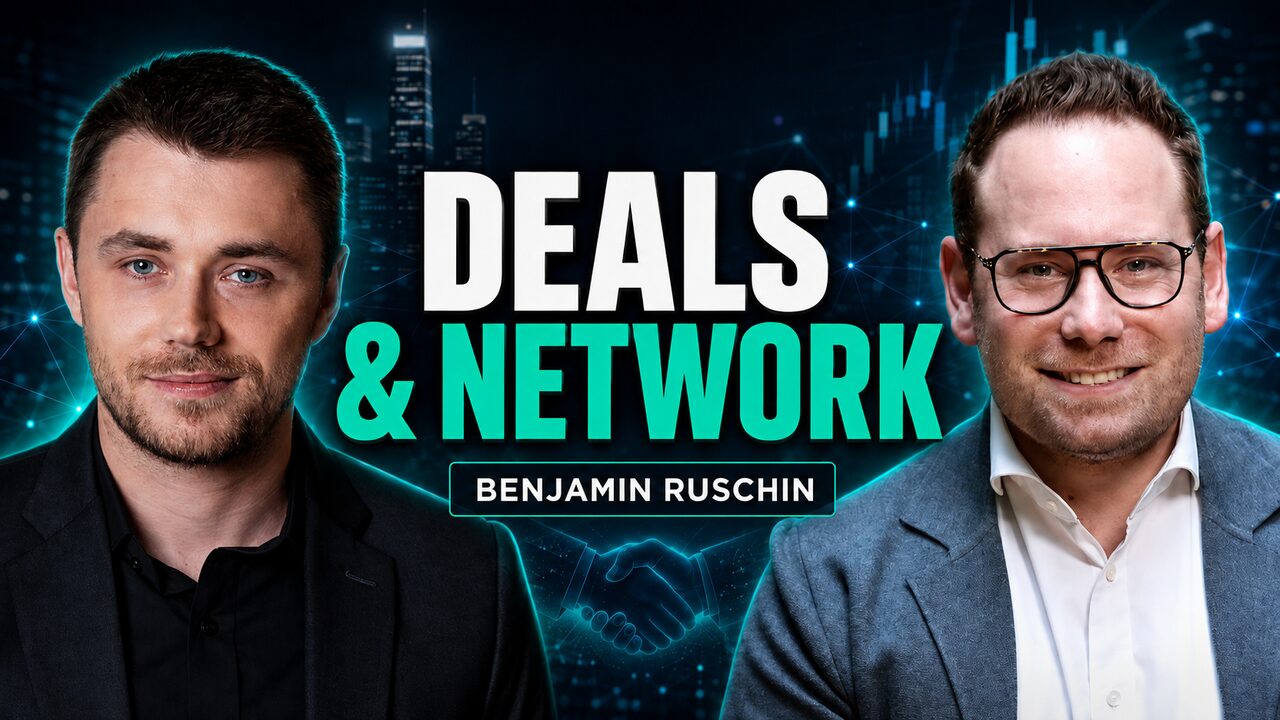
Benjamin Ruschin co-founded WeAreDevelopers, whose World Congress draws 15,000+ developers to Berlin. A conversation about deals, networks, investing and selling, recorded during his Big Cheese Ventures years.
- Ruschin’s first rule for early-stage sales: cash is king. WeAreDevelopers financed its team with event sponsorships, making a million in revenue in year one and almost four million annually before serious fundraising began.
- His fundraising rule: start long before you need the money. If runway ends in June 2024, start talking to investors now, share updates and numbers, and stand out by saying you are not currently raising.
- Honesty beats FOMO. Ruschin argues that rounds built on fake urgency backfire; when he and Big Cheese Ventures supported portfolio raises, the approach was to put every fact on the table before anyone invested, not after.
- On pricing, his test is value, never cheapness: be different or better and charge what convenience is worth. He paid double for a notary appointment because notarity let him book at 10 in the evening for 8 the next morning.
- Founder due diligence cannot happen in one meeting. Before investing, Ruschin would run workshops, business plan sessions, cold calls, and customer intros with founders to see how they react in real situations.
Who is Benjamin Ruschin, co-founder of WeAreDevelopers?
Watch this part · 0:00Kevin Hi everyone, welcome at Wavect. Today we have a super special guest, and most of you probably know one of his companies, WeAreDevelopers, and it's Benjamin Ruschin. Thank you for taking your time today. It's really a huge pleasure and an honor to have you on the show. First of all, I always like to give our guests some space to introduce themselves and say what they're passionate about right now, what they're working on. So if you want to, feel free to share that with us.
What did Big Cheese Ventures help early-stage founders with?
Watch this part · 0:44Benjamin Sure. So thanks for inviting me. It's an honor to be here. Yeah, I like to build companies. I think I'm best in the very early stage, so bringing them up to like 10 million in revenues, that's my specialty. A colleague of mine once said that there's people who like to build boats and then there's people who like to steer ships, and I'm better at building the boats than steering the big ship. So that's something I'm passionate about, and I really like to meet new people and I like to work with extraordinary people. So basically what I focus on with Big Cheese Ventures is working with extraordinary entrepreneurs who are brave enough to take a huge risk. They're risking, you know, spending years of their lives, spending a lot of money, spending opportunity costs on an idea, a vision, a passion of theirs, and they risk failure. So they risk that what they're working on for five years or 10 years will not work out in the end. And that's something I find very special and impressive, and it's something I respect a lot.
Benjamin And when I moved out from my previous company, where I'm still one of the major shareholders, WeAreDevelopers, and moved into their advisory board and then started focusing on Big Cheese Ventures, my goal was really to use the skills that I have in ramping up the revenue of a company, building the team, bring the company up to this kind of 10 million revenue goal. And I started, you know, thinking about how can I best support the entrepreneurs on their way. And one thing I can do, of course, is I can coach them. I can be their mentor. I can kind of guide them a little bit. But the other thing is I can help them bring the right money into the company. And with the right money, I mean, on the one hand, bring the right investors on board, investors who are, you know, nice people, have a good relationship with the founder, where there's really a connection between the two. I think that's very important. And on the other hand, investors who can add value, so not just cash, but also support the founder with connections, with mentoring, with ideas, with, you know, business development in any sense.
Benjamin And the other thing besides investors is I can help them to ramp up sales, so to really bring in revenues from clients, to bring in large customers, midsize customers and small customers, and show them how the sales has to be done. And what I learned in my own company, but I experienced this with 90% of the founders out there: ramping up your sales from zero is one of the hardest things in the company. Building a product is difficult, you know. Putting together a good team is also difficult. It depends on timing. It depends on luck. It depends on coincidences. But getting the sales thing right is quite challenging because it depends on a lot of different things. You need to hire the right people. You need to provide them with the right package. You need to manage them well. You need to provide them with the variable pay that will be attractive to them and to you. You need to get your pricing right. You need to have a product that really fits with the market. Your product needs to work technically. You need to have sales materials. You need to have, you know, your clearly defined customer persona, right? So there's so many different things that you need to get right.
Benjamin And if you've never done it before, it's really difficult to get all of these things right. And most of the founders you meet who've been around for a couple of years, I guarantee you, they've hired and fired salespeople quite a lot. They've hired people who didn't fit. They hired people who didn't perform for whatever reason. The pricing didn't work. They had no B2B marketing. So one of these many things that influences their sales success didn't work. And if one of these things doesn't work, then the whole thing doesn't work. That's the challenge. So those are the two things that my business partner and I work on with Big Cheese. We help entrepreneurs in the early stage to connect with the right investors, but we also help them to ramp up their sales at a very fast pace.
How do you do outbound sales in Austria without cold calls?
Watch this part · 5:36Kevin Speaking of sales, the first thing that comes to my mind when I speak with entrepreneurs, for example, is: especially here you are facing several constraints that you're probably not facing outside of Austria, which means you are not allowed to make cold calls for B2C, you are not allowed to make cold calls for B2B, which is even different from Germany, for example, and these kind of things. So I'm just wondering, what would you tell a young startup founder on how they should do outbound sales, for example, in the very early days, where they possibly can't afford a sales rep or an account executive?
Benjamin Well, I mean, founder-led sales happens in different ways. I think the most important thing is you need to be where your target group is. So if your target group is large automotive companies, then you need to attend events where the CEOs or CTOs, or whichever C is your target group, are speaking. So you go to, I don't know, the Web Summit, you go to [event unclear], where he's speaking. He's not a CEO anymore, but he's connected in this world. If you're targeting lawyers, then you need to go to legal tech conferences and to lawyers' congresses. So you need to be where the target group is. You need to understand them as best possible. So really talk to as many people from your target group as you can. A, to acquire them as customers, but also B, to really understand their needs and understand whether the way you are communicating and the way you are, you know, providing your solution is the right way, or if there's stuff you can improve.
Benjamin And, of course, LinkedIn is one of the best channels that's available to us, where you can contact people without any GDPR restraints, where you can also use personalized automation tools such as Octopus CRM or Linked Helper or, you know, other tools that are around, and where you can very quickly get an incredible reach. And that's what I would suggest. But understanding the target group, listening to what they have to say, continuing this kind of market research constantly is one of the most important things that a lot of founders get wrong.
How should startups price a B2B SaaS product?
Watch this part · 8:12Kevin You also spoke of fixing, or, not fixing, basically, when you are entering or buying a stake into a company. Many VCs or, let's say, incubators always also try to focus on fixing their pricing, right? And you approached that topic. I mentioned it earlier as well. I'm just thinking, what does that mean to you in terms of founder-led sales, for example? Because if you have a great offer, and I would also love to know what you consider to be a great offer, for example, then this process gets much easier, right? So what are some nuggets, let's put it that way, in terms of pricing or crafting a good offer for your potential target audience?
Benjamin The pricing needs to do two things. The first thing, it needs to be competitive so that your customers will pay the price. They will compare it to other offerings on the market. They will compare it to alternatives on the market. And they will weigh whether the benefits and the added value that you provide justify a higher price. The other thing is, the pricing ultimately needs to work for your business case. So being cheaper is never the solution. Being cost-effective is a good thing in the background, but being cheaper is not the right way. You have to differentiate, and you have to be different or better and add some value. So I think, first of all, you need to look at who is your competition. Sometimes you have competitors that do something very similar to you. They're also a platform that does whatever. But you also have competitors that come from a very different angle, but solve the solution in a similar way. So, for example, if you're providing a legal tech automation platform, this might be compared to other, you know, contract automation tools. But it might also be compared to the cost of employing lawyers to do the same thing.
Benjamin So you need to keep in mind who are the competitors, and you need to find a pricing that's, you know, within the scope of the market. It doesn't make sense to ask for ten times the price if you're not asking for ten times the value. I would also use some very common knowledge. Like, if you have a B2B SaaS product, then you usually have several different pricing offerings. So you have small, medium, and large. And usually medium is what the customers go for. Medium is usually the attractive offering, what you highlight. You know, it's yellow. It's in the middle of the page. And then you have enterprise and custom, and obviously the cheap version, which is usually not attractive because something important is missing. So in the end, everybody wins. Everybody goes for, like, the medium version. But scanning the market and also, again, talking to the customers about what they're prepared to pay, whether they think the pricing is fair or what they would do, is always a good thing. And I think, you know, if you're providing a product with an added value that really benefits the target group you're addressing, then they'll be prepared to pay a price for the value you provide. So, yeah, that's what I would recommend.
Why do customers pay a premium for convenience?
Watch this part · 11:53Kevin There is a really interesting, let's say, thought process that Alex Hormozi, not sure if you know him, mentioned a while ago. And that's: what kind of value, or what amount of value, or what do you need to do to actually charge 10x the price? Just that thought experiment. What would you do to create so much value that the client is possibly willing to pay that? And the same all the way around in terms of effectivity, right, that you mentioned as well. What would you need to do, or optimize, automate, to be able to just charge one-tenth of the price? And those are really interesting thoughts.
Benjamin Yeah, I think it's a good exercise to do. And just to give one example: notarity, a startup that I'm invested in. Basically they offer a platform where you can access notary services. So you can get a power of attorney, and the big benefit that they provide is you can get most of these services within 10 minutes. So a couple of months ago I was flying to Germany to attend a shareholders meeting. And I knew that I would be late for the meeting where a notary was present, and we wanted to do some notary stuff. I think it was a capital raise. And I realized the evening before that I'm going to be late for this meeting. What notarity provided was the solution that at 10 in the evening, I can book a notary meeting for eight in the morning, which is just before my flight departs at 8:20 or 8:30. And yes, the power of attorney probably costs twice as much as I would pay if I did it the normal way. But the normal way was not existent.
Benjamin So the fact that I could do this very quickly and didn't have to change my flights, didn't have to, you know, delay my visits or run around Vienna to find a notary that was open at eight in the morning, I was prepared to pay double. And I think that's what people need to keep in mind. How much costs are you saving for your clients, and how much value are you providing? And if it's justified, it's justified. We also attend conferences that cost 2,000, 3,000 euros for a ticket, because, you know, you win one client and it's a done deal.
Kevin Absolutely.
Benjamin Sorry, sorry. Yeah, it's a good exercise to do. What would you have to provide? And this ongoing dialogue in terms of how can you provide the maximum value and the maximum convenience for the customer. Because I think it's all about convenience. It's all about saving time. Time is the one limiting factor we all have. Everything needs to go faster. Everything needs to be easier. And I think that's where you can charge the highest premium. Take, for example, a non-startup example: why do a lot of people choose Erste Group, Erste Bank in Austria, as their bank? Because they have a convenient online banking, which all the other banks don't in Austria. It's very simple. But the value derived for the bank is huge.
Kevin Absolutely. Don't make me think. That's always something that you can capitalize on. But making things easier, faster, just, you know, the one thing that everyone really just has in a limited fashion is time, as you said. So that's a really, really good approach from my point of view as well.
How does an angel investor evaluate startups before investing?
Watch this part · 15:43Kevin Speaking of that, you are investing in technology. You are investing in a lot of startups, right? What I got told in the past is that when you invest into several startups, you always should keep in mind that umbrella approach, right, when investing into these companies, so that you don't get caught up in every deal one by one and have these things actually blocking you from your operative work. Just to shift that topic in a sec, I would be curious about your thoughts on this and how you established it for yourself. Because I can imagine that you don't actually create a 100% different contract for every new startup that you invest in. You might have some kind of onboarding process for that. I assume at least.
Benjamin I mean, firstly, I believe in a portfolio strategy. So I think putting everything onto one bet is not the right way to do it. At the same time, we're always talking about the portfolio strategy: you need to have at least 20 investments, or 10, or 30. Everybody has a different number in mind in order for the game to work for you. At the same time, some of the most successful people around us put everything on one bet, right? They founded one company and that went through the roof, or they invested in one or two or three companies and one of them or two of them went through the roof. So I think, if you're investing in companies, or let's stick with startups, fast-growing tech companies, I think you need to define your own strategy and you need to focus on what you believe in. It also depends, the whole thing, on how much time you're gonna dedicate and how much you're gonna get involved yourself in order to make the whole thing successful.
Benjamin I think the mistake that a lot of investors make is that they're very emotional about their decisions, even if they say otherwise. So everyone, or most people, will tell you what their investment thesis is. They'll have three verticals they invest in, they have a standard ticket size, they'll do follow-ons or they won't do follow-ons. But at the end of the day, you have to make the decision for yourself. And what we've seen is that most investors get very emotionally attached to a founder team, or to a founder in the team, and then make their decision based on a passion, based on an emotion. I think it's very difficult to standardize the investment process, you know, to a very high degree, because every situation is different. Every startup works with a different lawyer. Every startup has a different type of contract, et cetera. So unless you're like a top-tier VC who can dictate terms and who can dictate, you know, contractual templates, it's kind of difficult to standardize the whole thing. And I think even for VCs, it's difficult to bring a lot of standardization into the process.
Benjamin For me, the most important thing is, I need to understand the terms. I need to spend a lot of time with the founders to really understand what they're like. What kind of people are they? Are they resilient? Are they really passionate about what they're doing? Is this the only thing they're doing, or are they doing something else on the side, which is usually not a good idea? There's debates among angel investors on what's more important: having, you know, industry knowledge and only investing in stuff you really understand well, or having, you know, a good gut feeling and focusing more on the team, even investing in startups where you don't understand the vertical very well. I know a lot of investors who did the second. So they had a great team they invested in, you know, in some crypto scale-up that went through the roof. They did a couple hundred X. And now they're happy and, you know, kind of rocking the investor stages. I think the team is very important. Everybody will tell you the same thing. At the same time, doing like a founder due diligence is a very time-consuming process. It's nothing you can do in a single meeting.
Benjamin So back to, like, standardization and efficiency. Yes, there are deals that have to go very quickly, where you have a week to decide, and you can, like, meet the founder on a Friday afternoon and you have to sign something on Monday. I think you can do that with smaller tickets where you're not, like, risking too much. But I would not recommend investing in a startup if you have not spent considerable time with the founding team and really got to know them in situations that mirror what's going to happen in the startup. So what I like to do is I like to do workshops with the founders. I like to sit down, talk about the business plan, perhaps do some cold calling, bring in some customers. I like to do some intros to potential customers, see what their reactions are, see how the founders approach the situation, to kind of understand what's going on. And that's not a thing that happens very fast. It takes a lot of time. And I think that's the biggest challenge for startup investors: if you really want to understand what's going on, you really need to spend time with the startup. And that's time-consuming.
Do small angel tickets come down to gut feeling and team?
Watch this part · 21:54Kevin That's a really interesting approach. Something that I hear a lot is that especially for smaller ticket sizes, well, from 15K to, I would say, maybe a hundred K, it's usually somewhat founder-led, or, depends on the companies, also team-led, right? That you trust your gut. You look at the team. That's just what I heard and read. And after that, let's say the metrics themselves, like the industry and everything you talked about as well, was much more important. Applies that also to you, or are you actually really looking at those other factors before that, for these smaller ticket sizes as well?
Benjamin I try to understand the whole picture. And I'm not like an investor who throws in 10K, and if things go well, half a year later they'll throw in 200K or something like that. I like to go in big in the very beginning, because that's what makes a deal attractive. I'm prepared to take the risk, and I also try to bring in other investors so that I'm not, like, the only guy hanging in there if things don't go the way they should.
Benjamin So I think there's a big difference between a startup that has a bunch of, you know, experienced investors who've done this 10 or 20 times, who have a great network, who have the time and also are prepared to invest the time in order to help and support the founder with whatever it takes, versus startups where you have a bunch of people who've, you know, done this once or never before, didn't understand what they're getting into, perhaps don't have a network, perhaps don't have a reputation. And when things go the wrong way, you know, it all ends in a big conflict. Of course, I'm giving extreme situations, but that's something I do pay attention to: who else is investing, can we get some good names on board, and can we get some people or some funds on board where we know that when it hits the fan, they're gonna be there and they're gonna support and, you know, help us turn the ship back into the right direction.
Why does honesty matter when raising from investors?
Watch this part · 24:15Kevin It's always good to do that right away when you are investing, right? Because what I noticed is that a lot of investors also tend to then refer other investors when it already hits the fan, right? Because then they actually can't say, well, I'm going in that round as well, because I have already got a lot of people on board. So that's a huge challenge. And it's really important to be honest, and it always has that negative nuance to it, right? Why are you not increasing your stake if it's so great, and all these kind of things.
Benjamin Yes, or why are you not being honest. So that's, I think, a big challenge we have in general, that people who are already invested in a startup have an incentive to bring in new investors. And, you know, at the end of the day, if you're not honest, when the person, you know, invests, signs the contract, transfers the money, sooner or later they will find out that there's some things they should have been aware of, or that there's some legacy issues that they didn't know about. And it's never good for a startup. But that's a bit of an issue that I've come across a couple of times. And I think something that, you know, everyone in the startup scene needs to work on: being honest, putting facts on the table, talking very openly about the challenges that you're having in the company, and very openly talking about how you plan to solve these challenges. I think investors appreciate honesty. They appreciate transparency. And this is one of the most important, you know, things we focus on if we're supporting a founder with the round, if we're raising for one of our portfolio startups: being honest, putting all the facts on the table, so that everybody knows everything prior to investing in the company and not afterwards.
Kevin That strategy is actually also highly effective, but it's the same for sales. It's, in the end, nothing else, right, than a bridge of trust.
Benjamin Absolutely.
Kevin Some people call it, right? And I noticed that for myself: if you say to a client, well, I don't think that's the solution for you, and you give them something else, or even refer them to a competitor or something like that, that triggers a lot of positive reactions and leads to referrals and all these things, right? And the same, obviously, when you try to raise funds. If you have or gain or deserve that trust from investors by being honest, as you said, that's definitely a really good approach, in my opinion.
When should founders start raising their next round?
Watch this part · 27:08Benjamin Yeah, I mean, usually these things happen when startups are running out of time, right? Like, I had the situation a while ago, and an existing shareholder of a startup told me, you know, they're going to close the round soon, they're going to close the round, I don't even know if there's a ticket left for you guys, but let's see, you know, and you have to move fast. And in the end, it turned out that they weren't close to closing the round. They had some commitments, but it was far from being closed, and the urgency was not there. It was not necessary. And you invest in the startup, and you realize, okay, you know, that was not cool. It was not honest. They were trying to create FOMO because, you know, there was a liquidity squeeze and they had to close the round.
Benjamin And that brings me back to the most important point. When you're, like, raising a round, start long before you need the money. If you know that you have a runway until June 2024, start raising now, not in February, right? Start talking, you know, compile a list of potential investors, start talking to them, giving them updates, meet them for a coffee, meet them for a Zoom call, whatever. Tell them about what you're doing, present them your numbers. You're not raising right now, you're going to do a round next year. Investors always appreciate it if, you know, a founder contacts them and tells them, look, I'm not raising right now, but I want to talk to you about my company. I get a lot of messages on LinkedIn from founders who are raising, and I don't respond to most of them, because I can't. It's too many, you know? But I recently got a message from a guy who said, look, I want to talk to you about my startup. By the way, I'm not raising. And, like, this person stood out from the crowd because, you know, I don't know, was that you?
Kevin I'm not raising.
Benjamin Yeah, right. That was super effective, because it was like, okay, awesome. Somebody who's not raising. That was a really good idea. And I think you need to stand out. And I think if you want to get in touch with, you know, the right people, or you want to, you know, get a foot in the door, it's not a time to be aggressive, because everyone is being aggressive. Everyone is just throwing their deck out there, telling you their valuation and the size of their convertible and the deadline and their traction and all of this. And it's just too much. So now is the time to build relationships and, you know, not be on the edge because you have to close something in the next six weeks, otherwise the game is over for you. So timing is important. And I've also seen a lot of investors who declined an investment later turn around, because the founder just kept sending them updates and gave them infos about the traction, about new clients, about perhaps new investors coming in or things happening in the team. And then they appreciated the updates. They saw something they liked, and they, you know, made a 180-degree turn and decided to invest.
Kevin Yeah. As you said, it's about building relationships, right? As always, inboxes are destroyed, and everyone gets too many at the end. It comes from too many unrelated people, and it's just annoying at some point, right? Cold pitches, nobody likes them. Nobody likes to be sold to. And especially if you are in some position where people actively seek your, you know, investment, or know that you have money or whatever, you're always a target for a lot of different people that need something from you. And it's a negative feeling that you get, right? Because...
Benjamin And I think people appreciate if you have a genuine interest in each other. Of course, you're not going to contact everyone. You're going to contact certain people where you have an interest in, you know, getting something, some results. But people appreciate if you can just, you know, grab a lunch, grab a coffee, have a talk, and not, you know, kick in the door and try to access their bank account.
How should founders approach investors and successful people?
Watch this part · 31:25Kevin Interesting. Thank you so much. This is a really fun perspective that I heard a while ago. When I started with my podcast, right, I had, just like you yourself, a lot of guests on the show that intimidated me to some extent, right? From Stanford professors to former US Most Wanted, all these people, and investors like yourself, or serial entrepreneurs, and so on. And then you're sitting there, and this saying brought me back to reality: everyone is just human. And no matter what you achieved in some kind of way, right, there are different kind of ladders that you can climb, career, sports, whatever. Everyone has their own journey, basically. But in the end, everyone just wants to enjoy the process and have their goals and climb towards them and these kind of things, right? In the end, everyone has similar goals to some extent. And there's no reason to treat someone differently, right? Because it's just negative, right? If I'm starting to treat you, for example, like you're some kind of messiah or whatever, it's just not authentic, right?
Benjamin Yeah, I mean, I can fully subscribe to that. If you want to get in touch with them, drop them an email. Send this person an email. Talk to them. Just be normal. Don't look up to them and get all nervous and ask them for an autograph. They're not interested in this stuff. They just want to have a normal conversation, because they get a lot of this. I see this, for example, with my wife. She's an opera singer. Sometimes we're at the airport and someone charges at her and asks her for an autograph, and they're all nervous and stuff like that. It happens, yeah? And then it's really nice to just have someone who just says, hi, I like what you're doing, and can I talk to you and can I ask you a question? There's a huge difference. And I think it scares people. It alienates them. And it also embarrasses them if you're treating them like they're, you know, something else, like some superstar or something far from their reach, rather than just being normal and talking to them. Because at the end of the day, you know, before you go to work or do whatever you do in the evening, on the weekends, everyone's a human. So just treat them like that.
Kevin Absolutely.
Benjamin And I think that's one of the things that also came out of the whole VC scene. Even the super successful venture capital people are like, if I think about the most successful investors in my network, they wear old, you know, worn-out sneakers. They wear jeans. They wear a T-shirt. They're not going to run around with a flashy suit and, you know, show off their stuff, right? They're just going to be normal. And they're usually the least well-dressed people around, just because they have different priorities. And they're just normal individuals. And I think that's something I like about the whole venture capital and startup environment.
Why don't the most successful investors show off?
Watch this part · 34:59Kevin There's also an interesting viewpoint on this, right? What I've heard is that if you're new rich, you tend to clothe yourself in that way, right, that you actually look rich. And if you are in the game for quite some time, as you said, you're sick of it, right? You don't want it. And you are usually, right, I can speak, I know everyone here. And you prefer to be the undertaker or something like that, right?
Benjamin Yeah. I mean, I think it takes some discipline. What do founders do once they're successful and they have their exit? They usually change their living situation. You know, they'll buy a flat or a house. That's usually the first thing that comes. But I think it's easier said than done, you know, to transition into this situation where suddenly, like, your existence is safe. Like, you have this cushion and you don't really have to work anymore if you don't want to work. And you can buy yourself fancy cars or fancy watches or whatever it is that, you know, materialistically you want to have. But there's a big difference between those who keep it to themselves and those who, you know, have to show it to the world. And I think a lot of people want to show that they've been successful. But there's different ways to do this. And there's the people who talk about being successful, and then there's the people, you know, who are successful, but they don't talk about it so much. And I think for me, that was one of the biggest learnings and also decisions that I took for myself. I don't need to talk about being successful. I prefer to be successful and not talk about it so much.
Benjamin Because I also think that if you're spending your time and energy on trying to look successful or be perceived as successful, then you're wasting your energy on something that will not actually get you to that goal. And the people I know who are the most successful, they never stop striving for more success. But they're very focused on getting the things done that will help them reach their goals and help them become more successful, rather than trying to show people where they are at now. And yeah, I think that's also one of the sicknesses of the Austrian startup scene, for example, is that a lot of people want to be seen. They want to be on stages. People think they're successful because they look like they're successful, when in fact they're not. And they probably want to be successful, but they're just wasting their time and energy. And I don't want to do that. I don't want to be that kind of person. I want to be successful. But if nobody knows about it, it's also fine. Because at the end of the day, it's not going to help you move forward and be a happy person.
Kevin Right. Absolutely. In the end, it's about just enjoying your process, as everyone says, right? You hear it from every side.
What are three sales takeaways for founders under $1 million revenue?
Watch this part · 38:28Kevin Cool. Okay. Maybe last question, because I already took up a lot of your time. Are there maybe three key takeaways in terms of, let's say, to get back to sales in general, that you would tell a young founder, let's say up to, yeah, below $1 million in revenue? Because I think that's most people. What are the three key takeaways in terms of sales? What should they implement? What should they focus on? Because that's oftentimes an issue, right? What would you tell them?
Benjamin I think, first of all, there's two ways to approach this. One is to get it perfectly right from the outset. Like, I had this discussion with someone the other day on what's better: to have monthly payable pricing, where your clients can terminate the contract every month, versus having annual pricing, where they pay for the whole year and cannot terminate prior to the 12 months ending. What's the better strategy? What's the best strategy for young, early-stage B2B software-as-a-service startups? And there are two ways to look at this. Yes, the churn of customers if you're on a monthly price plan is going to be much more painful than the churn if you're on an annual price plan, which will arguably help you achieve a product-market fit faster than if you're on an annual plan. At the same time, money isn't growing on the trees at the moment. If you have an annual payment plan, the customer pays up front. You have a huge cash flow cushion that's helping you. So I think there's always a trade-off for everything.
Benjamin And you need to be very careful about which trade-offs you make. I'm more the person who likes to have an annual payment plan. I'm more the person who likes to have a lot of cash flow coming in and then taking their time to achieve the product-market fit, rather than going for the other way. That might be best practice, but that might also kill you on the way, because you're not going to have money to pay your team. So cash is king. That's the number one tip. Cash is king. Have cash coming in. WeAreDevelopers, we made our first revenues with event sponsorships, and we made a million in the first year. We made three and a half million the second year. Most of this was not SaaS revenue, but we had money coming in. We had an amazing team that we could finance. And when we started fundraising, we were making almost four million in annual revenues. So cash is king. That's the first thing. Second thing, I think it's a good idea to get senior mentors who've done this whole sales thing very successfully before to work with you. Bring them into the company, get them in your advisory board, incentivize them, let them invest a little, perhaps also incentivize them with some equity. But have professionals who've done all of this help you, so that you save a lot of time and you hit the floor running. If you don't have mentors who've done this before, you'll have to find it out the hard way, which is also okay, but it's going to take longer. And that's something you just have to be prepared for.
Benjamin And I think the third thing, and the most important thing, is to always get feedback from the market. Always keep your eyes open and always adapt your product, your pricing, your communication in order to really hit the G-spot of your target group. You really want to give them exactly what they want, and you'll have to find out what that is, and it can take some time. And sometimes it requires you to make more radical changes. But if you engineer your products in the wrong direction, you can waste a lot of resources, you can waste a lot of money, but you're not going to fulfill the need of your clients. So always keep in mind what the client wants. Talk to them, have an ongoing dialogue, whether it's ongoing focus groups once every couple of weeks or whether it's one-to-one meetings. Make sure you're on track, listen to them, because if you can fulfill the needs of a couple of customers in your target group, the chances are very high that you're going to fulfill the needs of the entire target group, or most of the target group. And that's what it's about: providing them with the value and giving them what they want.
Kevin Love it. Yeah. Lead with the customer, right? Market decides, who provides the most value, that company actually wins. It's usually that way, right? Or the strongest brand, but that's also some kind of value, right? Thanks, Ben, for jumping on. Really, I will put all relevant links into the video description for everyone listening to this. Thank you. Thank you very much for your time.
Benjamin Thank you for your time. Thanks for inviting me.
Questions this episode answers
Want this kind of thinking applied to your product?
We build MVPs and act as fractional CTOs for founders who'd rather ship than talk.