In this piece
A Measurable Road to Product-Market Fit
Product-market fit (PMF) is useful shorthand, but it is not a certification with one accepted test. A team must define the customer segment, problem, product, use case, price, channel, and observation window before its evidence can mean much. Fit can be strong in one segment and weak in another, and it can change when the product or market changes.
What PMF evidence should answer
A practical PMF case answers four questions:
- Problem: Does a defined group experience an important problem in a context the team understands?
- Value: Can the product help that group reach a meaningful outcome?
- Repeated behavior: Do relevant customers continue, renew, repeat, expand, or otherwise return to the value?
- Viability: Can the organization acquire, serve, support, and retain those customers under an acceptable economic and operational model?
Different products need different signals. Subscription software can inspect cohort retention and renewal. A marketplace must evaluate both sides and liquidity. A low-frequency workflow may rely on repeat eligibility, referrals, task completion, and willingness to pay rather than weekly usage. A services-assisted product must include human delivery cost and capacity in its economics.
Why a sale is useful but not conclusive
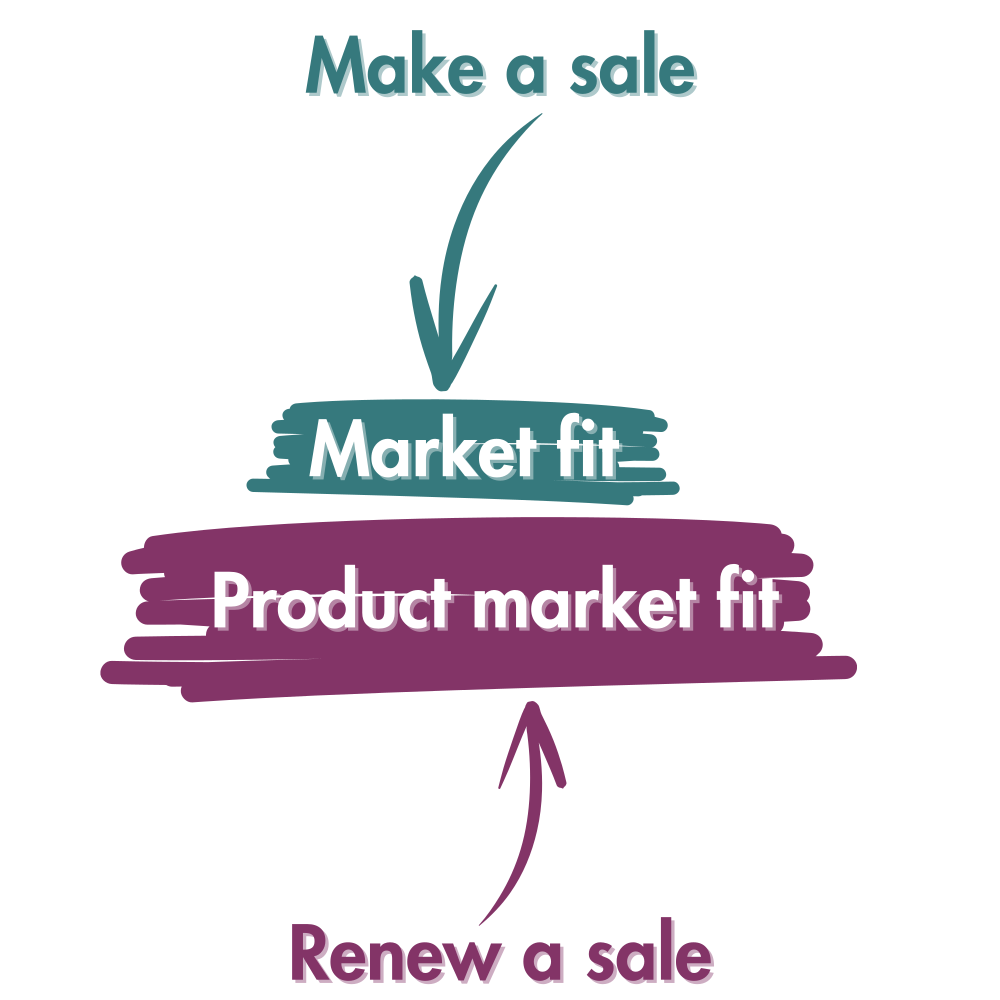
A paid transaction is stronger evidence than a compliment, but it can still reflect a founder relationship, a one-off budget, a custom commitment, heavy discounting, or a problem that does not recur. Conversely, a renewal is not the only valid signal for a transactional or infrequent product. Interpret behavior against the intended use and the reason the customer chose, used, and continued with the product.
Separate contracted revenue from repeatable product evidence. Record custom work, manual support, concessions, procurement effort, implementation cost, failed activation, refunds, churn reasons, and customers who would not buy under the standard offer. This prevents an aggregate revenue number from hiding a weak or non-repeatable segment.

"Product-market fit is a segment-specific evidence case, not a founder identity or a single dashboard number."
Replace founder stereotypes with testable work
There is no reliable rule that first-time founders focus on product, second-time founders on distribution, third-time founders on people, or fourth-time founders finally understand PMF. Experience can change judgment, networks, and access to capital, but founder count does not establish what a specific market needs.
Evaluate the work instead:
- Who is the target segment, buyer, user, and beneficiary?
- Which problem and current alternative have been observed?
- What must happen before a user reaches initial value?
- Which behavior shows repeated value for this product category?
- What price and buying process have been tested without hidden concessions?
- Which acquisition path is repeatable, and what does it cost?
- What support, reliability, privacy, security, and delivery work is required?
If you sell B2B software in Germany, Austria, or Switzerland, our DACH B2B SaaS validation framework separates user, buyer, procurement, privacy, and retention evidence.
Build a segment-level evidence table
| Evidence area | Questions | Common distortion |
|---|---|---|
| Problem | Is it frequent, costly, risky, or strategically important? | Interviewing only friendly contacts |
| Activation | Can the segment reach first value under the intended workflow? | Counting sign-ups instead of successful use |
| Repeated value | Does relevant behavior persist over a suitable period? | Mixing new and mature cohorts |
| Willingness to pay | Will the buyer accept the standard scope and price? | Hidden customization or founder-led concessions |
| Acquisition | Can the team reach qualified buyers through a repeatable channel? | Attributing founder network sales to a scalable channel |
| Economics | Do revenue and value support complete delivery and service costs? | Ignoring onboarding, support, infrastructure, and failed deals |
| Operations | Can quality and reliability hold as volume grows? | Using heroic manual work as the standard process |
Measure cohorts, not only aggregates
Aggregate growth can combine different segments, channels, prices, product versions, and customer ages. Cohorts make those differences visible. Group customers by a decision-relevant dimension, then compare activation, retained behavior, revenue, support burden, and churn over the same relative time window.
Define the event precisely. "Active" might mean a successful workflow completion, a recurring team process, a paid renewal, or marketplace supply that produced a transaction. Login counts may be meaningless for a product intended to run quietly. Track both leading behavior and the customer outcome it is supposed to predict.
Once the cohort definition is agreed, our Claude Dashboards and Motion workflow for product KPI videos shows how to check one activation result and carry its denominator, observation window and data cutoff into a short team update.
Set decision rules before reading the result
There is no universal retention curve, survey percentage, growth rate, or revenue threshold that proves PMF across products. Set thresholds from the product's frequency, risk, margin, buying cycle, and strategy. Document the data source, denominator, exclusions, segment, cohort start, observation window, and uncertainty.
Examples of decision rules include:
- continue a pilot if the target segment reaches the agreed outcome without unplanned manual intervention;
- revise onboarding if qualified users fail before first value;
- narrow the segment if retention differs materially by use case;
- stop a channel if qualified acquisition cannot support complete contribution economics;
- delay scaling if reliability, support, security, or compliance evidence is below the launch gate.
Testing a Product Direction?
Book Free ConsultationUse qualitative and quantitative evidence together
Behavioral data can show where users stop, return, pay, or leave. Research can explain why and expose needs the instrumentation missed. Neither should be used as decoration for a decision already made. Recruit relevant participants, include unsuccessful and churned users, record contradictions, and distinguish observed behavior from interpretation.
Customer requests are inputs, not automatically the roadmap. Translate them into the underlying job, constraint, and expected outcome, then test whether the pattern exists beyond the requester. This connects PMF work to the evidence-based prioritization framework in Escape the Feature Trap.
Know when scaling is premature
Scaling acquisition before the product reliably produces value can amplify churn, support load, and reputational cost. Scaling engineering before the target segment and workflow are stable can harden assumptions into architecture. Yet waiting for perfect certainty is also unrealistic. Use staged commitments with explicit evidence gates.
A pre-PMF team may need product, customer, commercial, technical, and domain leadership in different proportions. A fractional co-founder or fractional CTO can be one staffing option, but neither role is universally required before or after PMF. Choose a mandate based on the actual decision gap, authority, availability, and evidence needed.
Reassess fit after material change
PMF is not permanent. Reassess the evidence when the segment, buyer, use case, price, packaging, channel, regulation, competitive environment, product experience, or service model changes. A product can retain fit in an existing segment while a new expansion remains unproven.
Sources
- GOV.UK Service Manual: Learning about users and their needs
- GOV.UK Service Manual: Using performance data to improve a service
- Stripe: What product-market fit means for startups
- Y Combinator: The Real Product Market Fit
Final thoughts
Treat product-market fit as a dated, segment-specific evidence case. Define the market and intended value, measure activation and repeated behavior by cohort, test willingness to pay and acquisition, include complete service economics, and set decision rules before interpreting the data. Strong evidence supports the next commitment; it does not make fit permanent.