In this piece
Escape the Feature Trap with Evidence
A product team can ship many features and still fail to improve the outcome that matters. The opposite shortcut is also unsafe: releasing something small does not automatically make it useful, viable, secure, or ready for production. The practical goal is to connect each material investment to a user problem, a product objective, a testable assumption, and evidence that can change the next decision.
Building a Software Product?
Book Free ConsultationWhat a feature trap looks like
A feature trap appears when output becomes the dominant success measure. Roadmaps turn into lists of requested solutions, delivery teams are rewarded for completion, and the organization rarely checks whether released work changed user behavior or business performance. This is a governance problem, not proof that any particular feature is bad.
Warning signs include:
- requests arrive without a documented user problem or expected outcome;
- priority is determined mainly by requester seniority, sales pressure, or recency;
- the backlog grows while old items are rarely removed;
- launch is treated as completion, with no owner or measurement period afterward;
- maintenance, support, privacy, security, migration, and retirement costs are absent from the decision;
- teams cannot explain what evidence would stop or reverse the work.
Start with user needs, not a preferred solution
Research should distinguish a need from a proposed feature. Interviews, observation, support records, analytics, search logs, sales evidence, and operational data can reveal what people are trying to accomplish and where the current journey fails. Opinions from customers, executives, or the delivery team are useful inputs, but they remain assumptions until tested against relevant evidence.
Write the problem in terms of the affected user, context, obstacle, and desired outcome. Then define what would count as improvement. Depending on the product, that might be successful task completion, reduced error rate, faster time to value, fewer support contacts, higher retention, lower operational effort, or a risk-control outcome. A metric without a decision rule can still become reporting theater, so state what result would cause the team to continue, revise, stop, or investigate further.

"The smallest useful experiment is the one that can change a real product decision."
An MVP is an experiment boundary, not a feature count
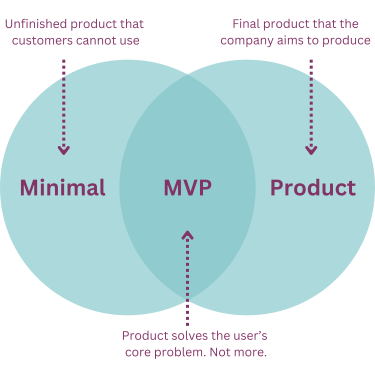
A minimum viable product should be scoped around what the team needs to learn or deliver, not a universal number of screens or features. Sometimes a clickable prototype is enough to test comprehension. Sometimes a concierge process tests demand without building automation. A regulated or safety-sensitive workflow may need substantial controls before any external pilot is responsible.
Ask four questions before choosing the artifact:
- Decision: Which specific decision will this evidence inform?
- Risk: Which assumption would be most damaging if false?
- Method: What is the least costly valid way to test it with the relevant users or system?
- Gate: What evidence permits expansion, requires revision, or stops the work?
A public launch is only one possible method. Internal prototypes, limited pilots, manual service delivery, technical spikes, and usability tests can reduce uncertainty without exposing a production audience. Release timing depends on security, privacy, accessibility, legal, reliability, support, and rollback requirements as well as market learning.
Order work with explicit criteria
No prioritization formula is universally correct. Scores can help structure a discussion, but weak inputs do not become objective because they were multiplied. A review should make at least these dimensions visible:
| Dimension | Question | Useful evidence |
|---|---|---|
| User outcome | Which verified need or barrier does this address? | Research, task data, support evidence |
| Product goal | How does it advance the current objective? | Goal, outcome metric, decision rule |
| Risk reduction | Which material uncertainty or control does it resolve? | Risk register, experiment result, threat model |
| Complete cost | What will delivery, operation, support, compliance, and retirement require? | Estimate basis, dependencies, owner |
| Urgency | Is there a dated legal, contractual, safety, or market constraint? | Primary source and effective date |
| Reversibility | How easily can the team change course? | Rollback, migration, exit plan |
Dependencies and mandatory work can change the order even when their direct product impact is hard to compare. Record the rationale and revisit it as evidence changes. The backlog is not a promise to build every item.
Use a product goal without turning it into a slogan
The Scrum Guide describes the Product Goal as a future state that serves as a planning target, and the Product Backlog as an ordered, evolving list of what is needed to improve the product. That structure can support focus, but the framework does not choose the right strategy for a team. The goal still needs evidence, a time horizon, decision rights, and observable outcomes.
A useful review asks whether the proposed work advances the current goal, whether a smaller experiment could answer the same question, and what existing work should be removed or delayed. When everything remains a priority, capacity is spread across competing objectives and the cost of finishing rises.
Account for the lifecycle after launch
Every production capability creates an operating surface. It may add permissions, data processing, dependencies, documentation, monitoring, support paths, analytics, migrations, and future compatibility work. More code does not mechanically mean more defects, but each additional behavior creates something the team must understand, verify, operate, and eventually change or retire.
Before committing, identify the long-term owner, service level, security and privacy obligations, instrumentation, support workflow, rollback path, and retirement conditions. A feature with weak expected value and permanent operating cost may rank below maintenance or simplification work even if it is easy to build.
A repeatable decision record
For a consequential backlog item, capture:
- the user problem and affected segment;
- the product goal and expected outcome;
- the evidence already available and its limits;
- the riskiest assumptions;
- the smallest valid experiment or increment;
- security, privacy, accessibility, legal, and operational gates;
- delivery and lifecycle cost ranges with assumptions;
- an owner, measurement window, and continue, revise, or stop criteria.
This record does not remove judgment. It makes the judgment reviewable and helps the team learn when reality differs from the original case.
Sources
- GOV.UK Service Manual: Learning about users and their needs
- GOV.UK Service Manual: Deciding on priorities
- The Scrum Guide
Final thoughts
Escaping the feature trap does not mean building as little as possible. It means investing in the smallest responsible step that advances a product goal or reduces a material uncertainty. Tie work to user evidence, complete lifecycle cost, explicit launch gates, and a result that can change the next decision.