Practical decisions for AI and software
Technical guides to choose models, verify software and plan delivery.
Search every article
Search the full article text.
No posts match your search. Try another term or pick a topic.
Latest articles
New comparisons, practical guides and engineering lessons.
 Delivery & QA
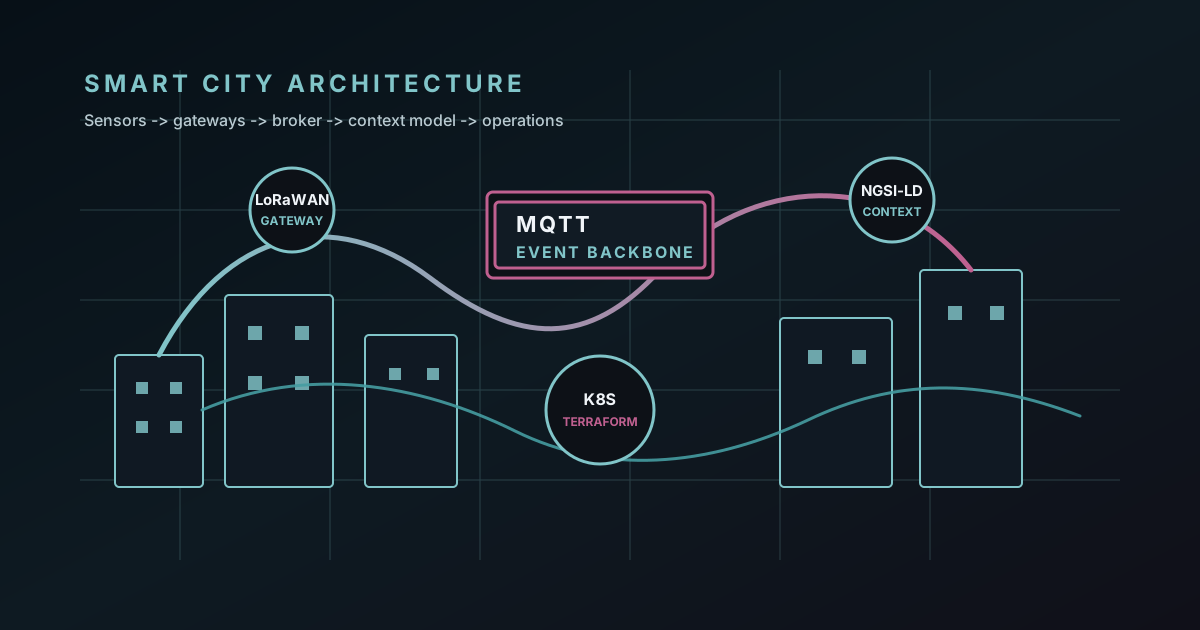
Smart City Architecture Best Practices: MQTT, LoRaWAN, Kubernetes and Terraform
A vendor-neutral guide to building smart-city platforms that survive production: MQTT at the edge, LoRaWAN and ChirpStack for private sensor networks, FIWARE/NGSI-LD and SensorThings for interoperability, Terraform for repeatable infrastructure, and Kubernetes only when the team can operate it.

 AI & Agents
AI Agent Cost per Action: Why Agentic Workflows Blow Up Token Bills
Executives do not buy tokens. They buy actions: support tickets resolved, invoices extracted, PRs reviewed and leads enriched. The calculator for tracing every model call, tool call, retry, verifier, cache hit and failed attempt into one cost per successful action.
 AI & Agents
When Local Models Beat APIs: A Break-Even Calculator for EU Companies
Self-hosting an LLM only wins when utilization, governance, and ops all line up. The calculator for comparing API spend against GPU hours, engineer time, eval upkeep, concurrency, and EU data residency.
 AI & Agents
LLM Cost Calculator 2026: Cost per Task, Not Cost per Token
The spreadsheet logic behind a real AI bill: count completed tasks, not token prices. Formulas for cached input, batch discounts, routing escalation, self-host utilization, retries, human rework and eval quality.
 Delivery & QA
The Factory Returns
How agentic AI revives the software-factory dream that failed twice, and whether agility can survive it. Alexandre Kotcherguine and Kevin Riedl weigh the technical-debt and productivity evidence on both sides, trace the craft moving up the stack into specifications and quality gates, and read Stripe’s agent fleet as the thesis observed in production.

 Web3 & Privacy
Building Real Applications With ZK and FHE in 2026: A Pragmatic Guide
Apple documents production HE lookups, Google Wallet announced ZK age assurance, and Ethereum proving now has multi-GPU real-time benchmarks. The decision tree, current evidence, and five common privacy-tech failure modes.
 Web3 & Privacy
Zero-Knowledge Proofs in 2026: What Is Actually Production-Ready
Proving an Ethereum block fell from 1.69 dollars to under 4 cents in one year, and ZK identity landed in Google Wallet. Which zkVMs to build on, what proving costs, what works on a phone, and where the security bodies are buried.
 Web3 & Privacy
Fully Homomorphic Encryption in 2026: What Ships and What Is Still Hype
FHE powers private lookups on Apple devices and encrypted transactions on Ethereum, but performance depends on the scheme, operation mix, parameters, and hardware. The production pattern that works and the encrypted-LLM reality check.
 Web3 & Privacy
ZK vs FHE vs MPC vs TEE: How to Choose in 2026
Four privacy technologies, four trust models, four price tags. The four questions that pick the right one, a side-by-side comparison with honest numbers, and the EU regulations that increasingly force the choice.
Get the next field note
One concise email when we publish. No tracking pixels, and no inbox filler.